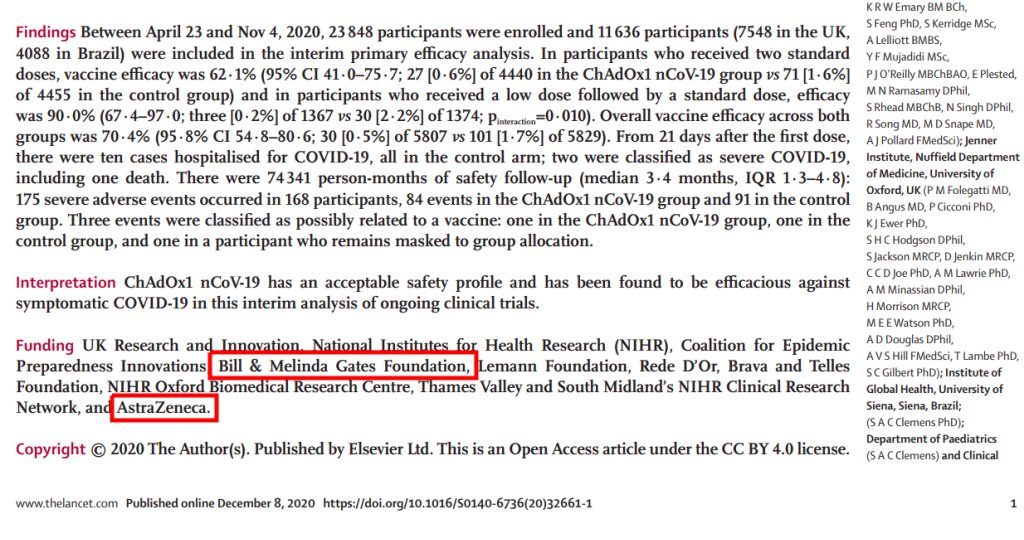
Randomised control trial study showing safety and efficacy of COVID-19 vaccine has clear conflicts of interest.
COVID-19 is a disease defined by symptoms and is not a virus. It’s therefore not transmitted nor can you test for it using nasal or throat testing kits. SARS-CoV-2 is the coronavirus that prompted the worldwide pandemic response.
Browse the articles related to this topic below.
Join our community on Guilded.
Randomised control trial study showing safety and efficacy of COVID-19 vaccine has clear conflicts of interest.
To guard against censorship, this is a mirror of the video posted by Leandra Ashton on 5 December.
New guidelines right? We can all see our loved ones if we have a negative test right?
On Dec 2nd my Mum asked for an in-person visit and was told ‘We have no tests’. Don’t worry, replied my Mum, I’ll get one done. The next day, having been tested she emailed a negative test result. This was met with another no: “We’re waiting for vaccinations before visiting can take place”.
The only option? Another inhumane window visit. Today, at the end of her 10 minute ‘visit’, kneeling on concrete by the window trying to connect with my Nan, my Mum raised concerns with the care assistant about how my Nan was looking. This is the response she was greeted with…
COVID-19 vaccines designed to elicit neutralising antibodies may sensitise vaccine recipients to more severe disease than if they were not vaccinated. Vaccines for SARS, MERS and RSV have never been approved, and the data generated in the development and testing of these vaccines suggest a serious mechanistic concern: that vaccines designed empirically using the traditional approach (consisting of the unmodified or minimally modified coronavirus viral spike to elicit neutralising antibodies), be they composed of protein, viral vector, DNA or RNA and irrespective of delivery method, may worsen COVID-19 disease via antibody-dependent enhancement (ADE). This risk is sufficiently obscured in clinical trial protocols and consent forms for ongoing COVID-19 vaccine trials that adequate patient comprehension of this risk is unlikely to occur, obviating truly informed consent by subjects in these trials.
The UK government has granted pharmaceutical giant Pfizer a legal indemnity protecting it from being sued, enabling its coronavirus vaccine to be rolled out across the country as early as next week.
The Department of Health and Social Care has confirmed the company has been given an indemnity protecting it from legal action as a result of any problems with the vaccine.
Ministers have also changed the law in recent weeks to give new protections to companies such as Pfizer, giving them immunity from being sued by patients in the event of any complications.
NHS staff providing the vaccine, as well as manufacturers of the drug, are also protected.
The army has mobilised an elite “information warfare” unit renowned for assisting operations against al-Qaeda and the Taliban to counter online propaganda against vaccines, as Britain prepares to deliver its first injections within days.
The defence cultural specialist unit was launched in Afghanistan in 2010 and belongs to the army’s 77th Brigade. The secretive unit has often worked side-by-side with psychological operations teams.
Leaked documents reveal that its soldiers are already monitoring cyberspace for Covid-19 content and analysing how British citizens are being targeted online.
https://www.thetimes.co.uk/edition/news/army-spies-to-take-on-antivax-militants-mfzsj66w2
Most people will escape “severe” side effects, defined as those that prevent daily activity. Fewer than 2% of recipients of the Pfizer and Moderna vaccines developed severe fevers of 39°C to 40°C. But if the companies win regulatory approvals, they’re aiming to supply vaccine to 35 million people worldwide by the end of December. If 2% experienced severe fever, that would be 700,000 people.
Other transient side effects would likely affect even more people. The independent board that conducted the interim analysis of Moderna’s huge trial found that severe side effects included fatigue in 9.7% of participants, muscle pain in 8.9%, joint pain in 5.2%, and headache in 4.5%. In the Pfizer/BioNTech vaccine trial, the numbers were lower: Severe side effects included fatigue (3.8%) and headache (2%).
But that’s a higher rate of severe reactions than people may be accustomed to. “This is higher reactogenicity than is ordinarily seen with most flu vaccines, even the high-dose ones,” says Arnold Monto, an epidemiologist at the University of Michigan School of Public Health.
https://web.archive.org/web/20201126203444/https://science.sciencemag.org/content/370/6520/1022
https://www.wired.com/story/the-astrazeneca-covid-vaccine-data-isnt-up-to-snuff/
Moderna Chief Medical Officer Tal Zaks warns on #AxiosOnHBO to not “over-interpret” vaccine results: “They do not show that they prevent you from potentially carrying this virus…and infecting others.” Adding, we shouldn’t “change behaviors solely on the basis of vaccination.”
Mirrors:
Two major U.S. pharmaceutical companies racing to develop novel coronavirus vaccines have announced that their vaccines have been confirmed to be over 90% effective. But Masayuki Miyasaka, a leading immunologist at Osaka University, told the Mainichi Shimbun in a recent interview that even after these vaccines become available, he does not plan to receive them for the time being.
At a meeting of the Committee on Health, Labor and Welfare of Japan’s House of Representatives on Nov. 17, Miyasaka stated, “There’s no doubt that their effectiveness is quite high, but their safety is not guaranteed at all,” sounding a word of caution about expectations for the vaccines.
https://mainichi.jp/english/articles/20201120/p2a/00m/0na/008000c
Pfizer’s vaccine “may be more than 90% effective.” (Mahase, BMJ 2020;371:m4347, November 9) Specific data are not given but it is easy enough to approximate the numbers involved, based on the 94 cases in a trial that has enrolled about 40,000 subjects: 8 cases in a vaccine group of 20,000 and 86 cases in a placebo group of 20,000. This yields a Covid-19 attack rate of 0.0004 in the vaccine group and 0.0043 in the placebo group. Relative risk (RR) for vaccination = 0.093, which translates into a “vaccine effectiveness” of 90.7% [100(1-0.093)]. This sounds impressive, but the absolute risk reduction for an individual is only about 0.4% (0.0043-0.0004=0.0039). The Number Needed To Vaccinate (NNTV) = 256 (1/0.0039), which means that to prevent just 1 Covid-19 case 256 individuals must get the vaccine; the other 255 individuals derive no benefit, but are subject to vaccine adverse effects, whatever they may be and whenever we learn about them……We’ve already heard that an early effect of the vaccine is “like a hangover or the flu.” Will vaccinees who are later exposed to coronaviruses have more severe illness as a result of antibody-dependent enhancement of infection (ADEI), a known hazard of coronavirus vaccines? Is there squalene in the Pfizer vaccine? If so, will vaccinees be subject to autoimmune diseases, like Gulf War Syndrome and narcolepsy that have been associated with the adjuvant?
| Actual Study Start Date : | April 29, 2020 |
| Estimated Primary Completion Date : | June 13, 2021 |
| Estimated Study Completion Date : | December 11, 2022 |
https://www.clinicaltrials.gov/ct2/show/NCT04368728?term=Pfizer&cond=SARS-cov-2&draw=2&rank=1
There’s just one curious problem: flu, it seems, has all but vanished.
The disappearing act began as Covid-19 rolled in towards the end of our flu season in March. And just how swiftly rates have plummeted can be observed in ‘surveillance’ data collected by the World Health Organisation (WHO).
https://www.dailymail.co.uk/health/article-8875201/Has-Covid-killed-flu.html
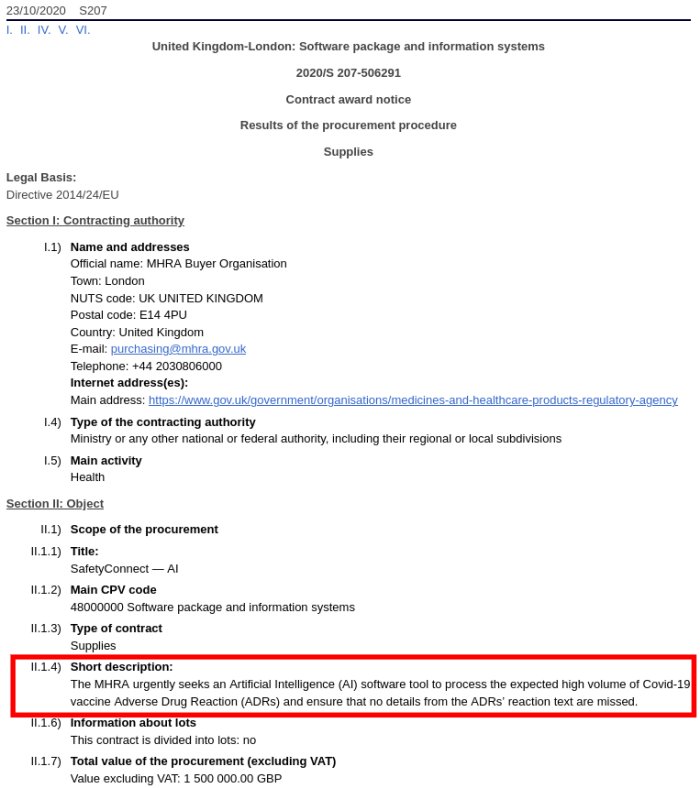
TED (Tenders Electronic Daily) is the online version of the ‘Supplement to the Official Journal’ of the EU, dedicated to European public procurement.
The MHRA urgently seeks an Artificial Intelligence (AI) software tool to process the expected high volume of Covid-19 vaccine Adverse Drug Reaction (ADRs) and ensure that no details from the ADRs’ reaction text are missed.
https://ted.europa.eu/udl?uri=TED:NOTICE:506291-2020:TEXT:EN:HTML&tabId=1
The world has bet the farm on vaccines as the solution to the pandemic, but the trials are not focused on answering the questions many might assume they are.
…But the truth is that the science remains far from clear cut, even for influenza vaccines that have been used for decades. Although randomised trials have shown an effect in reducing the risk of symptomatic influenza, such trials have never been conducted in elderly people living in the community to see whether they save lives.
Only two placebo controlled trials in this population have ever been conducted, and neither was designed to detect any difference in hospital admissions or deaths. Moreover, dramatic increases in use of influenza vaccines has not been associated with a decline in mortality
On 16 October, the Human Medicines (Coronavirus and Influenza) (Amendment) Regulations 2020 (SI 2020/1125) entered into force. The Regulations cover temporary authorisations for vaccines, civil liability and immunity for participants in vaccination programmes, expansion of the healthcare workforce who can administer vaccines, promotion of vaccines and an exemption to wholesale licensing requirement.
Certain COVID-19 vaccine candidates could increase susceptibility to HIV, warns a group of researchers who in 2007 learned that an experimental HIV vaccine had raised in some people the risk for infection with the AIDS virus. These concerns have percolated in the background of the race for a vaccine to stem the coronavirus pandemic, but now the researchers have gone public with a “cautionary tale,” in part because trials of those candidates may soon begin in locales that have pronounced HIV epidemics, such as South Africa.
Some approved and experimental vaccines have as a backbone a variety of adenoviruses, which can cause the common cold but are often harmless. The ill-fated HIV vaccine trial used an engineered strain known as adenovirus 5 (Ad5) to shuttle into the body the gene for the surface protein of the AIDS virus. In four candidate COVID-19 vaccines now in clinical trials in several countries, including the United States, Ad5 similarly serves as the “vector” to carry in the surface protein gene of SARS-CoV-2, the viral cause of the pandemic; two of these have advanced to large-scale, phase III efficacy studies in Russia and Pakistan.
In today’s issue of The Lancet, four veteran researchers raise a warning flag about those COVID-19 vaccine candidates by recounting their experience running a placebo-controlled AIDS vaccine trial dubbed STEP. An interim analysis of STEP found that uncircumcised men who had been naturally infected with Ad5 before receiving the vaccine became especially vulnerable to the AIDS virus. The vaccine, made by Merck, had been the leading hope for what was then a 20-year search for a shot that could thwart HIV. But after the STEP results appeared, the field went into a tailspin. “It took a decade to recover,” says one of the co-authors of the Lancet correspondence, Lawrence Corey of the Fred Hutchinson Cancer Research Center.
Lancet study: Use of adenovirus type-5 vectored vaccines: a cautionary tale