- Scientists should not be involved in devising and implementing policies.
- The window of opportunity to suppress the virus is gone.
- The toll on public health caused by closed borders will be absolutely awful.
- Indefinite suppression may not have ever been an option.
- Vaccines may be helpful but won’t be a silver bullet.
- The virus is here to stay.
- Vaccines may be effective in reducing symptoms but we can’t gamble on an infection blocking vaccine.
- Some vaccines aren’t always suitable for the entire population.
- Banking everything on a vaccine is not a reasonable approach.
- National level measures are not convincing; targeted measures have more potential.
- Communication has been problematic so public trust has been lost.
- Fear over a long period of time is physiologically unhealthy and doesn’t ever just evaporate.
- The cost of allowing people to choose their own risk-level would be much lower than the current blanket proposals.
- Well-targeted testing can be extremely effective but mass testing in schools is not a good use of tests.
- The ‘medicalization’ of society is worrying.
- Blanket testing of asymptomatic people is completely new and presents multiple ethical problems.
- Proportion of asymptomatic cases for 2009 influenza pandemic was around 50%-75%; this is similar to what we’re finding COVID-19.
- COVID-19 is not so different from other viruses but the global approach is completely different.
- Normalising the mass testing of otherwise healthy testing is very dangerous.
- There’s not much to be gained from comparing the measures and results between countries; the move to technocracy is dangerous.
- Whole societies should not turn around public health.
- A constant climate of fear is counter-productive.
- There were other countries that took a similar approach to Sweden, such as Switzerland.
- Past pandemics have been comparable to COVID-19 but did not have the same response.
- Outbreaks in care homes is nothing new.
- The pandemic phase of COVID-19 should eventually be over by mid to end of 2021 and in all likelihood become endemic.
- The most important message: COVID-19 presents a severe health crisis but it is not a ‘new normal.’
COVID-19
COVID-19 is a disease defined by symptoms and is not a virus. It’s therefore not transmitted nor can you test for it using nasal or throat testing kits. SARS-CoV-2 is the coronavirus that prompted the worldwide pandemic response.
Browse the articles related to this topic below.
Join our community on Guilded.
In fact, it is now becoming clear [Lockdown] is simply the wrong policy. Those who dissented from the Government’s Covid-19 strategy have been dismissed as mavericks on the fringes of the scientific establishment. However, this is no longer the case. I am afraid that the broadcast media has been particularly slow to reflect a shift in outlook among international scientists.
- As of October 2020, there are >1 million documented deaths with COVID‐19.
- Many early deaths may have been due to suboptimal management, malfunctional health systems, hydroxychloroquine, sending COVID‐19 patients to nursing homes, and nosocomial infections; such deaths are partially avoidable moving forward.
- About 10% of the global population may be infected by October 2020.
- Global infection fatality rate is 0.15‐0.20%
- Global infection fatality rate in those younger than 70 years old is 0.03‐0.04%.
- Targeted, precise management of the pandemic and avoiding past mistakes would help minimize mortality.
- The UK Government’s Test and Trace policy isn’t working and is worse than useless.
- 40 per cent of those asked to name their recent contacts were unable to remember anyone.
- The tests on which Test and Trace is based are highly unreliable.
- Covid is a coronavirus and its symptoms are vague: a cough, a raised temperature, the loss of taste and smell — all of which overlap with the symptoms for flu and the common cold.
- When the procedure goes wrong, it generates a ‘false positive’ result: it indicates an infection where none exists.
- Even with long-established tests, we’d expect to see false positives in perhaps one per cent of cases. With this one, it could quite conceivably be 5 per cent or higher.
- This means that if 300,000 tests are processed in a day, perhaps 15,000 or more will generate inaccurate reports of Covid-19 infection.
- One positive is not necessarily the same as another, but the Government numbers don’t differentiate.
- Last week, it was reported that just 1,800 out of 110,000 occupied beds in hospitals were taken up by Covid-19 patients.
- It is likely that those who died were elderly and suffering from co-morbidities such as heart disease and diabetes.
- But it is also possible that they died from something else entirely — such as flu.
- The UK Government’s Test and Trace policy isn’t working and is worse than useless.
- 40 per cent of those asked to name their recent contacts were unable to remember anyone.
- The tests on which Test and Trace is based are highly unreliable.
- Covid is a coronavirus and its symptoms are vague: a cough, a raised temperature, the loss of taste and smell — all of which overlap with the symptoms for flu and the common cold.
- When the procedure goes wrong, it generates a ‘false positive’ result: it indicates an infection where none exists.
- Even with long-established tests, we’d expect to see false positives in perhaps one per cent of cases. With this one, it could quite conceivably be 5 per cent or higher.
- This means that if 300,000 tests are processed in a day, perhaps 15,000 or more will generate inaccurate reports of Covid-19 infection.
- One positive is not necessarily the same as another, but the Government numbers don’t differentiate.
- Last week, it was reported that just 1,800 out of 110,000 occupied beds in hospitals were taken up by Covid-19 patients.
- It is likely that those who died were elderly and suffering from co-morbidities such as heart disease and diabetes.
- But it is also possible that they died from something else entirely — such as flu.
- Coronaviruses are as old as humanity and have resisted every attempt at a vaccine or a cure. One project to wipe out the common cold was funded for more than 40 years — and got nowhere.
- Today’s flu vaccines are less than 50 per cent effective, and there is no chance whatever that a hurriedly developed Covid-19 vaccine could be anything like as good as that.
A CORONAVIRUS vaccine may work but will need years to take effect if it does. Even in this best case scenario, Covid-19 will probably never be truly eradicated.
In fact, Mr Tegnell says, if any country was “following the science” – the phrase favoured by Boris Johnson – sense advice to alert its population.
Long-term lockdowns and facemasks are not the answer, he believes. “I can understand some countries situations were so bad they needed to do something drastic and it was tempting to lockdown,” he says.
https://www.express.co.uk/news/world/1343447/sweden-coronavirus-vaccine-no-lockdown
- Humans have lived with infectious diseases for at least 15,000 years.
- Until the early 2000s when we started to vaccinate for flu, we accepted that outbreaks would kill 20,000 to 50,000 people every winter without much comment.
- Self-isolation is not appropriate if you do not share the living conditions of the elites who make the rules – and that the risk does not seem proportionate to the benefits for ordinary people.
- Face covering, as practised, is irrelevant in most circumstances. The whole country should not be driven by the exceptional circumstances of rush hour in major cities. If most people are currently wearing face coverings, acknowledge that this is because they want to avoid trouble rather than to achieve protection.
- We will never eradicate the threat from coronaviruses because they are so widespread among animal populations.
None of this, however, explains the 40 years of medical
misinformation and suppression of the pharmaceutical truth.
To have covered up the knowledge for four decades that
viruses could potentially be treated by antimicrobials required
extensive effort:
• Censorship. It is likely that some scientists were never
published again after authoring one paper on the antiviral benefits of CQ.
• Buying silence of news media. This is evident from the
blackout across the political news spectrum concerning
vaccine adverse effects. Pharmaceutical manufacturers
provide the most lucrative advertising for both written
and broadcast news programs.
• Misdirection. For years, pharmacology professors in
medical schools have perpetuated lies of omission.
• Lies by drug companies. Merck was caught publishing its
own “peer reviewed” journal to promote its drugs.54
• Regulatory capture. “Big Pharma” essentially owns the
FDA by being its biggest funder and employing more
than 58 percent of the FDA’s upper-level regulators and
administrators either before or after their tenure.55,56
• Research funding. Big Pharma is the major funder of
nearly all “independent” drug research, and there is no
incentive to research cheap/ less profitable solutions.
The COVID-19 pandemic is calling attention to the
potential for treating viral diseases with currently available
drugs, and exposing long-available but ignored research.
The implications of all this are very disturbing. Where have
the virologists been, and the CDC “experts” who claim to care
about influenza deaths? Has the burgeoning nearly trilliondollar vaccine industry been built at the expense of patients’
lives?
The UK’s chief scientific adviser has a £600,000 shareholding in a drugs giant contracted to develop a Covid-19 vaccine for the Government, prompting claims of a potential conflict of interest.
- Sir Patrick Vallance, Chief Scientific Adviser to UK Government, was president of GSK 2012 – 2018
- Holds a deferred bonus of 43,111 shares worth £600,000
- Cashed in more than £5m worth of shares upon resignation of GSK
- Sir Vallance special board on vaccines
Dear Prime Minister, Chancellor, CMOs and Chief Scientific Adviser
We are writing with the intention of providing constructive input into the choices with respect to the Covid-19 policy response. We also have several concerns regarding aspects of the existing policy choices that we wish to draw attention to.
In summary, our view is that the existing policy path is inconsistent with the known risk-profile of Covid-19 and should be reconsidered. The unstated objective currently appears to be one of suppression of the virus, until such a time that a vaccine can be deployed. This objective is increasingly unfeasible (notwithstanding our more specific concerns regarding existing policies) and is leading to significant harm across all age groups, which likely offsets any benefits.
Instead, more targeted measures that protect the most vulnerable from Covid, whilst not adversely impacting those not at risk, are more supportable. Given the high proportion of Covid deaths in care homes, these should be a priority. Such targeted measures should be explored as a matter of urgency, as the logical cornerstone of our future strategy.
In addition to this overarching point, we append a set of concerns regarding the existing policy choices, which we hope will be received in the spirit in which they are intended. We are mindful that the current circumstances are challenging, and that all policy decisions are difficult ones. Moreover, many people have sadly lost loved ones to Covid-19 throughout the UK. Nonetheless, the current debate appears unhelpfully polarised around views that Covid is extremely deadly to all (and that large-scale policy interventions are effective); and on the other hand, those who believe Covid poses no risk at all. In light of this, and in order to make choices that increase our prospects of achieving better outcomes in future, we think now is the right time to ‘step back’ and fundamentally reconsider the path forward.
Yours sincerely,
Professor Sunetra Gupta; Professor of theoretical epidemiology, the University of Oxford
Professor Carl Heneghan; Director, Centre for Evidence Based Medicine, the University of Oxford
Professor Karol Sikora; Consultant oncologist and Professor of medicine, University of Buckingham
Sam Williams; Director and co-founder of Economic Insight
https://www.spectator.co.uk/article/boris-needs-to-rethink-his-covid-strategy
- Sweden never went in to full lockdown. Instead, the country imposed a partial lockdown that was almost entirely voluntary.
- The only forcible restriction imposed by the government from the start was a requirement that people not gather in groups of more than 50 at a time.
- People followed the voluntary restrictions pretty well at the beginning, but that they have become increasingly lax as time has gone on.
- After an initial peak that lasted for a month or so, from March to April, visits to the Emergency Room due to covid had been declining continuously, and deaths in Sweden had dropped from over 100 a day at the peak in April, to around five per day in August.
- Dr. Rushworth hasn’t seen a single covid patient in the Emergency Room in over two and a half months.
- COVID has killed under 6,000 people.
- On average, one to two people per day are dying of covid in Sweden at present, and that number continues to drop.
- In the whole of Stockholm, a county with 2,4 million inhabitants, there are currently only 28 people being treated for covid in all the hospitals combined.
- Sweden seemed to be developing herd immunity, in spite of the fact that only a minority had antibodies, was due to T-cells.
- Immunity may be long lasting, and probably explains why there have only been a handful of reported cases of re-infection with covid, even though the virus has spent the last nine months bouncing around the planet infecting many millions of people.
- Almost all cases of reinfection have been completely asymptomatic.
- People develop a functioning immunity after the first infection, which allows them to fight off the second infection without ever developing any symptoms.
- England and Italy have mortality curves that are very similar to Sweden’s.
- Lockdown only makes sense if you are willing to stay in lockdown until there is an effective vaccine.
https://sebastianrushworth.com/2020/09/19/covid-19-does-sweden-have-herd-immunity/
Leading scientists across the world say rushing the development of a coronavirus vaccine to bring it to the public before the end of this year is unrealistic, unsafe, and even “crazy”.
Despite reports from across the world suggesting a vaccine could be ready in weeks – particularly from the United States, where “Operation Warp Speed” reportedly has officials on standby to distribute the vaccine by October, ahead of the presidential election – experts are increasingly concerned that the rhetoric is in no way matched by the data.
None of the leading vaccine candidates have yet completed clinical trials, the regulatory bodies who licence vaccines are already struggling to cope with coronavirus demands, and questions over manufacture and distribution haven’t been considered, experts say.
…In normal times, a vaccine takes up to ten years to develop, including several years of testing. Under the current plans outlined by politicians in the UK, Russia, and the United States, this has been crunched to less than 12 months.
The choice we face is stark. One option is to maintain a general lockdown for an unknown amount of time until herd immunity is reached through a future vaccine or until there is a safe and effective treatment. This must be weighed against the detrimental effects that lockdowns have on other health outcomes. The second option is to minimise the number of deaths until herd immunity is achieved through natural infection. Most places are neither preparing for the former nor considering the latter.
The question is not whether to aim for herd immunity as a strategy, because we will all eventually get there. The question is how to minimise casualties until we get there. Since Covid-19 mortality varies greatly by age, this can only be accomplished through age-specific countermeasures. We need to shield older people and other high-risk groups until they are protected by herd immunity.
Among the individuals exposed to Covid-19, people aged in their 70s have roughly twice the mortality of those in their 60s, 10 times the mortality of those in their 50s, 40 times that of those in their 40s, 100 times that of those in their 30s, and 300 times that of those in their 20s. The over-70s have a mortality that is more than 3,000 times higher than children have. For young people, the risk of death is so low that any reduced levels of mortality during the lockdown might not be due to fewer Covid-19 deaths, but due to fewer traffic accidents.
https://www.spiked-online.com/2020/04/29/delaying-herd-immunity-is-costing-lives/
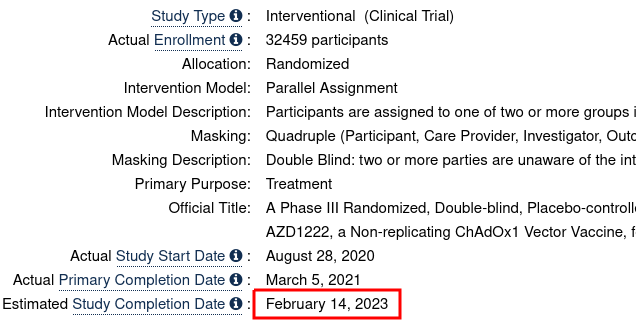
Brief Summary:The aim of the study is to assess the safety, efficacy, and immunogenicity of AZD1222 for the prevention of COVID-19.
| Actual Study Start Date : | August 28, 2020 |
| Actual Primary Completion Date : | March 5, 2021 |
| Estimated Study Completion Date : | February 14, 2023 |
Humans have never been particularly good at eradicating entire viruses, and COVID-19 might not be any different.
More than 19 million people have tested positive for the coronavirus globally, and at least 722,000 have died. In the U.S., nearly 5 million people have tested positive and more than 160,000 have died. While scientists are racing to find a cure for the virus, there’s a chance COVID-19 will never fully go away — with or without a vaccine.
Vineet Menachery, a coronavirus researcher at the University of Texas Medical Branch, told NPR’s Weekend Edition that one of the more likely scenarios is that the spread of COVID-19 will eventually be slowed as a result of herd immunity. He said that he’d be surprised “if we’re still wearing masks and 6-feet distancing in two or three years” and that in time, the virus could become no more serious than the common cold.
The first thing to remember is that we haven’t been successful at eradicating many viruses at all. Really the lone exception is smallpox, but many of these viruses exist not only in the human population but in animal populations. So coronaviruses may be removed from the human population, like SARS coronavirus in 2002, but we know that those viruses or viruses that are similar to it still exist in nature and at any time they may gain the tools to reemerge in humans again.
Sky News host Alan Jones says people are being swept up into a sense of hysteria and alarmism around COVID-19.
There are only 17 people in hospital with the coronavirus in NSW, eight of them in intensive care, while the World Health Organisation continue to maintain that 99 per cent of all cases will experience mild symptoms.
“I don’t think there’s going to be a vaccine, and we’re going to have to learn to live with this,” Mr Jones told Sky News host Chris Smith.
“But we learned to live with a whole lot of other communicable diseases.
“More people are dying from the flu with a vaccine than are dying from coronavirus without a vaccine.”
- Your immune system’s ‘memory’ T cells keep track of the viruses they have seen before.
- New study led by scientists at La Jolla Institute for Immunology (LJI) shows that memory helper T cells that recognize common cold coronaviruses also recognize matching sites on SARS-CoV-2, the virus that causes COVID-19.
- Having a strong T cell response, or a better T cell response may give you the opportunity to mount a much quicker and stronger response.
- 40%-60% of people never exposed to SARS-CoV-2 had T cells that reacted to the virus showing that their immune systems recognized the virus.
- This finding turned out to be a global phenomenon and was reported in people from the Netherlands, Germany, the United Kingdom and Singapore.
- This discovery suggests that fighting off a common cold coronavirus can induce cross-reactive T cell memory against SARS-CoV-2.
https://medicalxpress.com/news/2020-08-exposure-common-cold-coronaviruses-immune.html
- Article based on experience working as a doctor in the emergency room of one of the big hospitals in Stockholm, Sweden, and of living as a citizen in Sweden.
- Unlike other countries, Sweden never went in to complete lockdown. Non-essential businesses have remained open, people have continues to go to cafés and restaurants, children have remained in school, and very few people have bothered with face masks in public.
- COVID hit Stockholm like a storm in mid-March. One day I was seeing people with appendicitis and kidney stones, the usual things you see in the emergency room. The next day all those patients were gone and the only thing coming in to the hospital was COVID. Practically everyone who was tested had COVID, regardless of what the presenting symptom was. People came in with a nose bleed and they had COVID. They came in with stomach pain and they had COVID.
- Then, after a few months, all the COVID patients disappeared.
- At the peak three months back, a hundred people were dying a day of COVID in Sweden, a country with a population of ten million. We are now down to around five people dying per day in the whole country, and that number continues to drop. Since people generally die around three weeks after infection, that means virtually no-one is getting infected any more.
- The risk of dying is at the very most 1 in 200 if you actually do get infected.
- In total COVID has killed under 6,000 people in a country of ten million.
- Sweden has an annual death rate of around 100,000 people. Considering that 70% of those who have died of COVID are over 80 years old, quite a few of those 6,000 would have died this year anyway.
- COVID will never even come close to major pandemic numbers like 1918 flu.
- If herd immunity hasn’t developed, where are all the sick people? Why has the rate of infection dropped so precipitously?
- The reason we test for antibodies is because it is easy and cheap. Antibodies are in fact not the body’s main defence against virus infections. T-cells are. But T-cells are harder to measure than antibodies, so we don’t really do it clinically.
- Sweden ripped the metaphorical band-aid off quickly and got the epidemic over and done with in a short amount of time, while the rest of the world has chosen to try to peel the band-aid off slowly.
- I am willing to bet that the countries that have shut down completely will see rates spike when they open up. If that is the case, then there won’t have been any point in shutting down in the first place, because all those countries are going to end up with the same number of dead at the end of the day anyway. Shutting down completely in order to decrease the total number of deaths only makes sense if you are willing to stay shut down until a vaccine is available. That could take years.
- COVID has at present killed less than 6000 in Sweden. It is very unlikely that the number of dead will go above 7,000. An average influenza year in Sweden, 700 people die of influenza. Does that mean COVID is ten times worse than influenza? No, because influenza has been around for centuries while COVID is completely new.
- So it is quite possible, in fact likely, that the case fatality rate for COVID is the same as for influenza, or only slightly higher, and the entire difference we have seen is due to the complete lack of any immunity in the population at the start of this pandemic.
Original source: https://sebastianrushworth.com/2020/08/04/how-bad-is-covid-really-a-swedish-doctors-perspective/
AstraZeneca has been granted protection from future product liability claims related to its COVID-19 vaccine hopeful by most of the countries with which it has struck supply agreements, a senior executive told Reuters.
With 25 companies testing their vaccine candidates on humans and getting ready to immunise hundred millions of people once the products are shown to work, the question of who pays for any claims for damages in case of side effects has been a tricky point in supply negotiations.
“In the contracts we have in place, we are asking for indemnification. For most countries it is acceptable to take that risk on their shoulders because it is in their national interest,” he said, adding that Astra and regulators were making safety and tolerability a top priority.
Clinical trials:
- Phase I clinical trials simply test the safety of a drug or vaccine in a small number of healthy volunteers — usually brave and naïve college students.
- Phase II trials are responsible for testing its effectiveness in a larger number of subjects.
- A hyped-up and exuberant response to a Phase I trial as seen with Moderna press release is rare and nearly unheard of.
- Little information is gleaned from an investigational drug in Phase I that has many more hurdles to overcome before it successfully gets to market
- 77 percent of vaccines for infectious diseases make it through Phase I, but only 33 percent make it through the entire process overall.
Moderna’s RNA vaccine
- Upon examining Moderna’s non-peer reviewed press release, the actual data on the vaccine’s success is even more flimsy.
- When it comes to finding out whether the vaccine elicits an antibody response that could potentially fight the coronavirus, they only had data on eight patients out of the 45 patients who received the vaccine.
- The only data Moderna mentioned when it comes to determining whether the vaccine was clinically effective against the coronavirus were from mice.
- History also proves that success in animal models is often not replicated in human studies.
- Moderna’s messenger RNA vaccine is completely new and revolutionary. Messenger RNA vaccines have never before been brought to market for human patients
- It uses a sequence of genetic RNA material produced in a lab that, when injected into your body, must invade your cells and hijack your cells’ protein-making machinery called ribosomes to produce the viral components that subsequently train your immune system to fight the virus.
- Some messenger RNA vaccines are self-amplifying. That means they can force the cell to replicate more copies of itself.
- There are unique and unknown risks to messenger RNA vaccines, including the possibility that they generate strong type I interferon responses that could lead to inflammation and autoimmune conditions.
Oxford Vaccine Group’s vaccine:
- Oxford Vaccine Group has a competing vaccine that does not need to invade and hijack our cells’ own machinery.
- From a medical and clinical perspective, there is less risk of generating a type I interferon response and autoimmunity because there is no messenger RNA floating around our blood, invading our cells.
- In July Health Secretary Matt Hancock claimed that conspiracy theorists are putting lives at risk
- The UK government’s Vaccine Damage Payment scheme is proof that vaccines can be unsafe
- Eligibility criteria Vaccine Damage Payment changed in 2015
- Update October 2020: AstraZeneca protected from vaccine liability
- Update November 2020: MHRA expects high volume of COVID-19 vaccine adverse drug reaction
- Update December 2020: Pfizer is given protection from legal action by the UK government
Discussion around vaccinations can be very contentious. There’s great nuance in this area and a short post will not do justice to the complex issues surrounding the usefulness and safety of vaccines. Nevertheless, while vaccines may have their role in protecting target populations from disease, not all have been proven safe to an acceptable level as shown in the resources below.
The UK government’s Vaccine Damage Payment scheme is probably the strongest proof that vaccines can be unsafe. Under the Vaccine Damage Payment scheme, people who have been severely disabled as a result of a vaccination against certain diseases can be eligible for a one-off tax-free payment of £120,000.
Conspiracy theorists are putting lives at risk?
It is an objective fact that a compensation scheme exists for those who have been damaged by vaccines. Nevertheless, Health Secretary Matt Hancock claimed that conspiracy theorists are putting lives at risk:
“Those who promulgate lies about dangers of vaccines that are safe and have been approved–they are threatening lives…”
Source: The Independent, 20 July 2020
Clearly, concerns about the safely of vaccines cannot be lies if there is a vaccine damage compensation scheme in place.
Eligibility changed in 2015
Eligibility requirements for vaccines covering certain diseases are listed and change over time. Interestingly, sometime around 2015, damage from vaccines for influenza caused by pandemics are explicitly listed as not eligible.
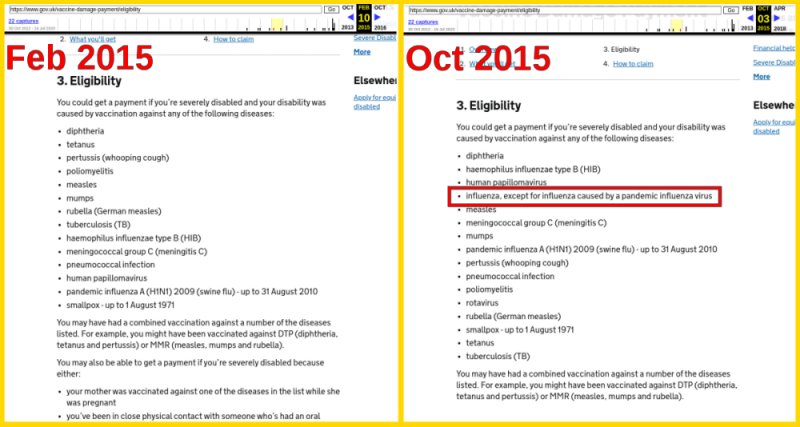
We do not know how the government compiles is eligibility criteria or why this change was made. However, it would be worthwhile to keep an eye on this list to see if the status of the upcoming COVID-19 vaccines.
AstraZeneca protected from vaccine liability
Update 1 August 2020: On 30 July 2020, Reuters reported that AstraZeneca, the UK government’s partner for developing its COVID-19 vaccine, will be exempt from coronavirus vaccine liability claims in most countries. The countries have not been named but Ruud Dobber, a member of Astra’s senior executive team, commented:
“This is a unique situation where we as a company simply cannot take the risk if in … four years the vaccine is showing side effects.
In the contracts we have in place, we are asking for indemnification. For most countries it is acceptable to take that risk on their shoulders because it is in their national interest.”
MHRA expects high volume of COVID-19 vaccine adverse drug reaction
Update November 2020: It came to light in mid-November that the UK’s Medicines & Healthcare products Regulatory Agency (MHRA) put out a contract award notice for an Artificial Intelligence (AI) software tool. It appears they expect a high volume of COVID-19 vaccine Adverse Drug Reaction (ADRs) from the upcoming vaccines:
…it is not possible to retrofit the MHRA’s legacy systems to handle the volume of ADRs that will be generated by a Covid-19 vaccine. Therefore, if the MHRA does not implement the AI tool, it will be unable to process these ADRs effectively.
Pfizer given legal indemnity
Update 2 December 2020: According to the Independent, Pfizer now has a legal indemnity from being sued by patients who develop any complications from its new mRNA vaccine that will be rolled out in the UK. NHS staff providing the vaccine will also be protected.
Resources
- UK Government Vaccine Damage Payment (gov.uk)
- Ministers lose fight to stop payouts over swine flu jab narcolepsy cases (The Guardian)
- Dengue vaccine fiasco leads to criminal charges for researcher in the Philippines (Science Magazine)
- Polio outbreaks in Africa caused by mutation of strain in vaccine (The Guardian)
- Pakistan accused of cover-up over fresh polio outbreak – (The Guardian)
- The Vaccination Debate (The Guardian)
- AstraZeneca to be exempt from coronavirus vaccine liability claims in most countries (Reuters)
- Zostavax Lawsuit (ClassAction.com)
- Pfizer to pay £50m after deaths of Nigerian children in drug trial experiment (The Independent)
- MHRA urgently seeks software tool to process the expected high volume of Covid-19 vaccine Adverse Drug Reaction (Tenders Electronic Daily)
- Pfizer given protection from legal action by UK government (The Independent)
View all articles related to COVID-19 and vaccination.