In the end, there was no statistically significant difference between those who wore masks and those who did not when it came to being infected by Covid-19. 1.8 per cent of those wearing masks caught Covid, compared to 2.1 per cent of the control group. As a result, it seems that any effect masks have on preventing the spread of the disease in the community is small.
…there is a troubling lack of robust evidence on face masks and Covid-19…The only studies which have shown masks to be effective at stopping airborne diseases have been ‘observational’…But observational studies are prone to recall bias: in the heat of a pandemic, not very many people will recall if and when they used masks and at what distance they kept from others.
Face Masks
There is no strong medical consensus on whether face masks help outside of health care settings. However, there does seem to be evidence that they can have negative health effects for the wearer.
According to Professor Russell Viner, president of the Royal College of Paediatrics and Child Health, children could spread COVID-19 more if they wear masks.
HM Government guidance for restaurants, pubs, bars and takeaway services, 24 June 2020:
“The evidence suggests that wearing a face covering does not protect you…evidence of the benefit of using a face covering to protect others is weak.”
Browse the articles related to this topic below.
Join our community on Guilded.
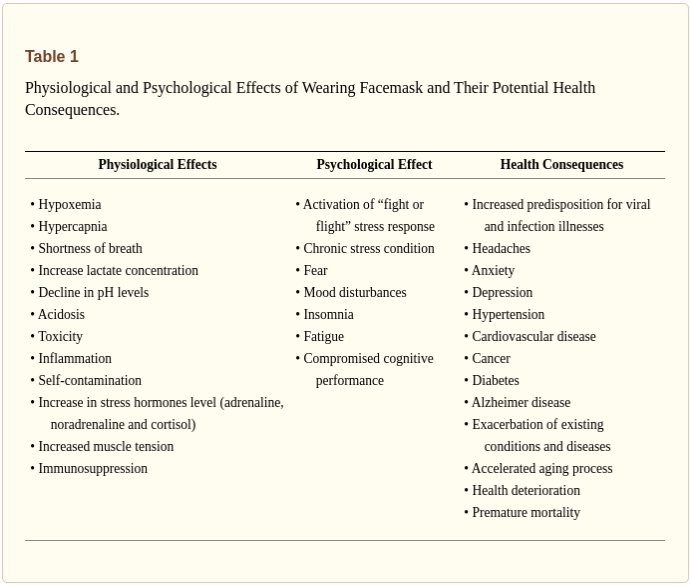
Many countries across the globe utilized medical and non-medical facemasks as non-pharmaceutical intervention for reducing the transmission and infectivity of coronavirus disease-2019 (COVID-19). Although, scientific evidence supporting facemasks’ efficacy is lacking, adverse physiological, psychological and health effects are established. Is has been hypothesized that facemasks have compromised safety and efficacy profile and should be avoided from use. The current article comprehensively summarizes scientific evidences with respect to wearing facemasks in the COVID-19 era, providing prosper information for public health and decisions making.
…The data suggest that both medical and non-medical facemasks are ineffective to block human-to-human transmission of viral and infectious disease such SARS-CoV-2 and COVID-19, supporting against the usage of facemasks. Wearing facemasks has been demonstrated to have substantial adverse physiological and psychological effects.
The recommendation to wear surgical masks to supplement other public health measures did not reduce the SARS-CoV-2 infection rate among wearers by more than 50% in a community with modest infection rates, some degree of social distancing, and uncommon general mask use. The data were compatible with lesser degrees of self-protection.
- AIDS was a testing pandemic, just like COVID-19.
- Many of the excess deaths for COVID-19 were due to inappropriately high dosages of hydroxychloroquine during experimental study trials.
- High COVID-19 excess deaths stopped after the trials were ended.
- Professor Martin Landry, leader of the UK-based Recovery trial, may have made a mistake in proposing high dosage of hydroxychloroquine. It seems he confused it with diiodohydroxyquinoline, treatment for treatment of amoebiasis.
- The treatment caused the damage.
- The danger of over-treatment is everywhere because the industry wants to sell diseases.
- COVID-19 is a self-limiting disease.
- The data shows that COVID-19 has no more killing potential than the yearly flu.
- Masks and lockdowns are ridiculous and damaging the whole population.
- It’s a political thing and not a health problem.
- Remdesivir is an immunosuppressant and useless against COVID-19.
- You have to live with viruses and you can’t fight against them.
- There is no treatment against COVID-19.
- The treatment against COVID-19 is to rest, like the flu.
- The problem is testing. If you stop the test, you’ll see nothing.
- Lockdowns were an overreaction.
- Vaccines are probably not a solution. You’ll have to vaccinate everyone every year. It’s good businesses.
Categories
The SARS-CoV-2 Pandemic
In the interest of public debate, we allow visitors to share opinions, experiences and research that may be of value to others. This is a visitor contribution from our Discussions page.
The views expressed are those of the individual posters themselves. Please read our Comments and contributions disclaimer.
Author
George Michael
- Credentials: Physics graduate, University College London (UCL); Senior Research Analyst
- Contact: LinkedIn
The SARS-CoV-2 Pandemic
The COVID-19 pandemic has impacted the world at a horrific scale, and people are trying to form their own opinions — rightly so — on topics ranging from disease severity to government policy. However, the general public are not exposed to a consistent flow of reliable information, so many are suffering from fear, confusion, and isolation, exacerbated by extreme differences in opinion on how seriously any aspect of the pandemic should be taken. These are the problems that this report aims to address.
Read the full article on Medium: The SARS-CoV-2 Pandemic
Interview highlights
- COVID-19 is not a dread disease that will kill everyone.
- The initially high case fatality rate of COVID-19 was because the medical community didn’t know how to treat it.
- The fatality rate of flu is 0.1% (1 in every 1,000 who are infected end up dying).
- Ventilators are the wrong option if you do not have an obstructed airway disease.
- Prod. Ioannidis: The infection fatality ratio of COVID-19 is 0.15%. This is pretty much the same as the flu.
- We should just ask people to be careful but otherwise go about your daily life.
- These things pass every year. This is the first ‘social media pandemic.’
- The normal practice for intensive care beds in the NHS is to run them almost full. This is because a lot of intensive care bed assignment is planned.
- ICU use at the height of the pandemic was has very low because the NHS was run as light as possible to cope with a second wave.
- Respiratory viruses don’t do waves.
- This is not opinion but is basic understanding among experts in the field. It is supposrted by the highest quality science. Sir Patrick Vallance knows this.
- COVID-19 follows the Gompertz Curve.
- You have immunity after your body has fought off a respiratory virus. If that was not the case, you’d be dead. Immunity probably lasts decades based on evidence from other viruses.
- Gompertz Curve is identical in all heavily infection regions.
- Something awefull happened in the middle of the year: PCR swab test.
- It is not true that if you test more people you’ll save more lives. A certain percentage of the test will come up positive even if there’s no virus in you.
- False positive rate wasn’t released.
- Kate Barker wrote in a government document on June 3rd, 2020, to SAGE: test has an unknown false positive rate; based on similar tests it may be between 1%-2%. This is a big deal.
- Based on 1%: for every 1,000 people you test, 10 will come back positive, even if they don’t have the virus. If prevalence is only 0.1% as reported by ONS, only 1 in 1,000 will be genuine. This means 9 in 10–in other words 90%–are false.
- Pillar 2 testing would have caused of the most of the positives to be false.
- 1,700 people die normally every day in the UK. During the summer, only about 10 were dying per day of covid.
- More testing, more false positives. We’ll never escape covid if we keep testing because most of the positives will be false. This is immunology 101. Sir Patrick Vallance would have known this.
- Influenza is a high mutation-rate virus. Coronaviruses are relatively stable so once you’ve recovered, you are probably immune for decades.
- COVID-19 kills 0.15%-0.2%, slightly more lethal than the average flu. Once it’s gone through the population, it won’t come back.
- 99.94% survive COVID-19 and will be resistant for a long time.
- COVID-19 is 80% similar to SARS-COV-1.
- People who were exposed to SARS have T-cell immunity 17 years later. Evidence for COVID-19 all point in direction.
- Our bodies have many lines of defense, including innate immunity and T-cells. Antibodies are in the last line of defense.
- Study shows around 30% prior immunity to SARS-COV-2. It was due to exposure to common-cold coronaviruses.
- The claim made by Sir Patrick Vallance that more than 90% are susceptible is a lie.
- Mass testing of the well populating is the worst problem as it generates false positives, fear and control.
- If you’re immune, you can’t be infected or infectious. Herd immunity is already in play in London.
- If SAGE is correct, London should be ‘ablaze’ with deaths.
- Current testing methods are not forensically sound.
- Tests detect common cold and dead virus.
- SARS-COV-2 has never really been a public health emergency.
- We do not need the vaccine to return to normal. Most people are not in danger from COVID-19. More people are in danger from car crashes and we accept that risk.
- Best case scenario is that the vaccine is 50% effective. Natural immunity might be better.
- The most vulnerable often don’t respond well to vaccines and die anyway.
- SAGE is giving lethally wrong advice.
- The reason the pandemic is not over is because SAGE says it’s not.
Masks have been shown consistently over time and throughout the world to have no significant preventative impact against any known pathogenic microbes. Specifically, regarding COVID-19, we have shown in this paper that mask use is not correlated with lower death rates nor with lower positive PCR tests.
Masks have also been demonstrated historically to contribute to increased infections within the respiratory tract. We have examined the common occurrence of oral and nasal pathogens accessing deeper tissues and blood, and potential consequences of such events. We have demonstrated from the clinical and historical data cited herein, we conclude the use of face masks will contribute to far more morbidity and mortality than has occurred due to COVID-19.
We call for collaborative efforts from scientists, manufacturers, and regulators to assess such risks and look for viable methods to reducing micro(nano)plastics and other respirable debris in face masks and respirators worn by a large population worldwide during the current pandemic.
There is no biological history of mass masking until the current era. It is important to consider possible outcomes of this society-wide experiment. The consequences to the health of individuals is as yet unknown. Masked individuals have measurably higher inspiratory flow than non-masked individuals. This study is of new masks removed from manufacturer packaging, as well as a laundered cloth mask, examined microscopically. Loose particulate was seen on each type of mask. Also, tight and loose fibers were seen on each type of mask. If every foreign particle and every fiber in every facemask is always secure and not detachable by airflow, then there should be no risk of inhalation of such particles and fibers. However, if even a small portion of mask fibers is detachable by inspiratory airflow, or if there is debris in mask manufacture or packaging or handling, then there is the possibility of not only entry of foreign material to the airways, but also entry to deep lung tissue, and potential pathological consequences of foreign bodies in the lungs.
Airborne simulation experiments showed that cotton masks, surgical masks, and N95 masks provide some protection from the transmission of infective SARS-CoV-2 droplets/aerosols; however, medical masks (surgical masks and even N95 masks) could not completely block the transmission of virus droplets/aerosols even when sealed.
- Humans have lived with infectious diseases for at least 15,000 years.
- Until the early 2000s when we started to vaccinate for flu, we accepted that outbreaks would kill 20,000 to 50,000 people every winter without much comment.
- Self-isolation is not appropriate if you do not share the living conditions of the elites who make the rules – and that the risk does not seem proportionate to the benefits for ordinary people.
- Face covering, as practised, is irrelevant in most circumstances. The whole country should not be driven by the exceptional circumstances of rush hour in major cities. If most people are currently wearing face coverings, acknowledge that this is because they want to avoid trouble rather than to achieve protection.
- We will never eradicate the threat from coronaviruses because they are so widespread among animal populations.
A curated list of mask facts and medical publications.
COVID-19 is as politically-charged as it is infectious. Early in the COVID-19 pandemic, the WHO, the CDC and NIH’s Dr. Anthony Fauci discouraged wearing masks as not useful for non-health care workers. Now they recommend wearing cloth face coverings in public settings where other social distancing measures are hard to do (e.g., grocery stores and pharmacies). The recommendation was published without a single scientific paper or other information provided to support that cloth masks actually provide any respiratory protection. Let’s look at the data.
- Surgical masks are loose fitting. They are designed to protect the patient from the doctors’ respiratory droplets. There wearer is not protected from others’ airborne particles.
- People do not wear masks properly. Many people have the mask under the nose. The wearer does not have glasses on and the eyes are a portal of entry. If the virus lands on the conjunctiva, tears will wash it into the nasopharynx.
- Most studies cannot separate out hand hygiene.
- The designer masks and scarves offer minimal protection. They give a false sense of security to both the wearer and those around the wearer.
**Not to mention they add a perverse lightheartedness to the situation. - If you are walking alone, no need for a mask. Avoid other folks; use common sense.
- Remember: children under 2 years should not wear masks because of accidental suffocation and difficulty breathing in some.
- Even if a universal mask mandate were imposed, several studies noted that folks do not use the mask properly and over-report their wearing. Additionally, how would the mandate be enforced??
- The positive studies are models that assume universality and full compliance.
- If wearing a mask makes people go out and get Vitamin D – go for it. In the 1918 flu pandemic people who went outside did better. Early reports are showing people with COVID-19 with low Vitamin D do worse than those with normal levels. Perhaps that is why shut-ins do so poorly.
My 30 years of working in academic environments, as both a scientist and a clinical academic, tell me this: a scientist’s career objective is to big up his subject, which increases his personal likelihood of gaining grants, influence and promotion. Scientists focus on narrow topics, often almost to the exclusion of everything else. Perspective is rarely a strong point. The more their subject is in the public eye, preferably centre stage, the better it is from a career point of view. Any crisis is, I’m afraid, a career opportunity for some. Unbiased, agenda-free, selfless public service is not, I believe, a key feature of academic life, nor is there any real reason to expect it to be.
The management of the Covid ‘crisis’ – a crisis substantially caused by the very management itself – has all the hallmarks of government being advised by a group of experts in the limelight, in thrall to groupthink, and with far too cosy a consensus to do effective science.
https://www.spiked-online.com/2020/09/25/the-making-of-britains-covid-catastrophe/
Plastic face shields are almost totally ineffective at trapping respiratory aerosols, according to modelling in Japan, casting doubt on their effectiveness in preventing the spread of coronavirus.
A simulation using Fugaku, the world’s fastest supercomputer, found that almost 100% of airborne droplets of less than 5 micrometres in size escaped through plastic visors of the kind often used by people working in service industries.
In addition, about half of larger droplets measuring 50 micrometres found their way into the air, according to Riken, a government-backed research institute in the western city of Kobe.
Sky News host Alan Jones says he has warned time and time again the political leaders who are the architects of this coronavirus response will not be able to escape the criticism that is now finding its way into the public place. It comes as an economist in the Victorian Department of Finance and Treasury, Sanjeev Sabhlok, on Wednesday penned an article in the Australian Financial Review announcing his resignation from his position.
- Policies are a sledgehammer to kill a swarm of flies.
- The Spanish Flu killed killed at least 50 million out of 1.8 billion people out of worldwide.
- To compare with Spanish Flu, COVID-19 would need to kill 210 million people. It has only killed 0.9 million.
- 60 million people worldwide normally die each year.
- There are strong scientific arguments against lockdown.
- The data was clear from February that the elderly should be protected but this wasn’t done.
- Epidemiological models have badly exaggerated the risk.
- There was never any reason to mandate measures such as face masks.
- COVID-19 is no worse than the Asian Flu.
- Lockdowns cannot eradicate the virus.
As coronavirus cases rise in pretty much all other European countries, leading to fears of a second wave including in the UK, they have been sinking all summer in Sweden. On a per capita basis, they are now 90 per cent below their peak in late June and under Norway’s and Denmark’s for the first time in five months. Tegnell had told me the first time we spoke in the spring that it would be in the autumn when it became more apparent how successful each country had been.


https://www.ft.com/content/5cc92d45-fbdb-43b7-9c66-26501693a371
“In the 14 days before illness onset, 71% of case-patients and 74% of control participants reported always using cloth face coverings or other mask types when in public.”
The face mask requirement at school is bad for children’s general well-being and should be abolished, 70 doctors wrote in an open letter to Flemish Education Minister Ben Weyts.
…The doctors mentioned anxiety and sleep problems as well as behavioural disorders and germaphobia, which is a pathological fear of germs. They are also seeing an increase in domestic violence, isolation and deprivation.
“Mandatory face masks in schools are a major threat to their development. It ignores the essential needs of the growing child. The well-being of children and young people is highly dependent on emotional attachment to others,” they wrote.
Moreover, “there is no large-scale evidence that wearing face masks in a non-professional environment has any positive effect on the spread of viruses, let alone on general health. Nor is there any legal basis for implementing this requirement.”
- When it comes to preventing the spread of respiratory infections, N-95 masks might be better than surgical face masks, and surgical face masks are probably better than cloth masks.
- Cloth masks may not provide any protection at all.
- If you or someone in your household is sick, you probably don’t need to bother wearing a mask at home. The infection will spread at the same rate within the household regardless.
- Face masks do seem to slightly decrease the risk of spreading respiratory infections outside the household setting. However, it is questionable whether an intervention that only impacts one in 24 people, and that only decreases the relative risk of infection by 17%, is having a big enough effect to noticeably slow the speed at which a highly infectious disease like covid-19 spreads through a population.
- Rather than require that everyone wear a mask at all times when out in public, it might make more sense to restrict mask use to specific situations like nursing homes.
https://sebastianrushworth.com/2020/09/05/do-face-masks-stop-respiratory-infections/
FORCING school children to wear masks is part of a scattergun approach by a government “lacking the political will” to study the actual evidence, a professor warns.
Dr Carl Heneghan said that the mask doctrine came into place even as the deputy chief medical officer admitted there was no strong evidence they would help with the disease. This was despite the social and psychological damage masking pupils would cause, he said. He pointed out that with drug interventions, high quality testing was required before they were implemented.
…He said: “Wearing masks can interfere with social wellbeing. We clearly understand with drugs the need to do proper research on the benefits against the harms before we use them.
This is a huge intervention to impose on society with many unknowns and potentially damaging consequences, but we are not doing the research to justify it.”