A hospital worker with no history of allergies was admitted to intensive care over a severe reaction she suffered 10 minutes after having Pfizer’s coronavirus vaccine. The unidentified female worker suffered an anaphylactic reaction shortly after receiving the injection at a hospital in Juneau, Alaska, on Tuesday.
Two healthcare workers in the UK suffered an anaphylactic reaction to the Pfizer injection after being given it last week, although the vaccine has been widely tested and analysed, with government experts in both the US and Great Britain deeming it safe.
Vaccination
It is uncontroversial that all medicines carry the risk of side-effects. As a society, we therefore make a tradeoff between the seriousness of the disease and the risk that a medicine may do some harm. This is the same thought process behind the COVID-19 vaccines. Unfortunately, inaccurate information about the new COVID-19 vaccines have caused a great deal of misinformation to circulate.
View our COVID-19 Vaccination page designed to help you make an informed choice.
Browse the articles related to this topic below.
Join our community on Guilded.
Making the jab mandatory or pressurising employees to have it could lead to criminal implications, says David Sheppard
The Law
There are no statutory provisions that could force individuals to become vaccinated. The Public Health (Control of Disease) Act 1984 specifically states that members of the public should not be compelled to undergo any mandatory medical treatment, including vaccinations.
If any government of the UK were to insist on compulsory vaccination, it could feasibly give rise to objections on the grounds of individual liberty and human rights. This is owing to article 8 of the European Convention on Human Rights, which protects people from being interfered with physically or psychologically and includes mandatory vaccinations.
Can businesses force employees to vaccinate?
In short, no. In theory, if there is a thorough medical examinations clause in a contract of employment, it could be relied upon. However, this would still be fraught with risk, and freely given consent is required for any medical intervention.
https://www.peoplemanagement.co.uk/experts/legal/can-employers-force-staff-to-have-the-covid-vaccine
Prolonged SARS-CoV-2 RNA shedding and recurrence of PCR-positive tests have been widely reported in patients after recovery, yet these patients most commonly are non-infectious. Here we investigated the possibility that SARS-CoV-2 RNAs can be reverse-transcribed and integrated into the human genome and that transcription of the integrated sequences might account for PCR-positive tests. In support of this hypothesis, we found chimeric transcripts consisting of viral fused to cellular sequences in published data sets of SARS-CoV-2 infected cultured cells and primary cells of patients, consistent with the transcription of viral sequences integrated into the genome. To experimentally corroborate the possibility of viral retro-integration, we describe evidence that SARS-CoV-2 RNAs can be reverse transcribed in human cells by reverse transcriptase (RT) from LINE-1 elements or by HIV-1 RT, and that these DNA sequences can be integrated into the cell genome and subsequently be transcribed. Human endogenous LINE-1 expression was induced upon SARS-CoV-2 infection or by cytokine exposure in cultured cells, suggesting a molecular mechanism for SARS-CoV-2 retro-integration in patients. This novel feature of SARS-CoV-2 infection may explain why patients can continue to produce viral RNA after recovery and suggests a new aspect of RNA virus replication.
http://archive.today/2021.12.24-130415/https://pubmed.ncbi.nlm.nih.gov/33330870/
Nearly half of care home staff won’t take the coronavirus vaccine, with bosses desperately calling on ministers to make jabs compulsory among healthcare workers.
Nadra Ahmed, chairman of the National Care Association, said as many as 40% of carers could choose not to take up the option as it is rolled out over the coming days.
Ms Ahmed told BBC Radio 4’s Today programme: ‘We know that between 50-60%, depending on individual services, the staff are actually saying they will definitely have the vaccine and are very keen.
‘We understand between about 17-20% of staff in services are saying they definitely won’t have it, and then you have the rest who are waiting to see.
‘So we are looking at potentially 40% who decide not to have it.’
A promising Australian candidate for a coronavirus vaccine has been abandoned after trial participants returned false HIV positive results.
Australia had previously agreed to buy 51 million doses of the vaccine being developed by Australian firm CSL and the University of Queensland (UQ).
The government said orders of other vaccines would now fill the shortfall.
CSL and UQ stressed that the positive results were false – meaning trial participants’ health was not at risk.
http://archive.today/2020.12.11-112743/https://www.bbc.com/news/world-australia-55269381
More than 100,000 patients will not be able to get the Covid vaccine from their family doctor after their GP surgeries decided not to take part in its deployment, the Guardian can reveal.
White House chief of staff Mark Meadows told the head of the Food and Drug Administration on Friday to either sign off on Pfizer’s coronavirus vaccine by the end of the day or hand in his resignation, the Washington Post reported, another push by the White House to approve the vaccine as quickly as possible after a panel of scientists ruled it safe this week.

Little is known about the interests of the doctors, scientists, and academics on whose advice the UK government relies to manage the pandemic. Attempts to discover more are frequently thwarted, finds Paul D Thacker.
https://web.archive.org/web/20201210214506/https://www.bmj.com/content/371/bmj.m4716
“We fully support the swine flu vaccination programme … The vaccine has been thoroughly tested,” they declared in a joint statement.
Except, it hadn’t. Anticipating a severe influenza pandemic, governments around the world had made various logistical and legal arrangements to shorten the time between recognition of a pandemic virus and the production of a vaccine and administration of that vaccine in the population. In Europe, one element of those plans was an agreement to grant licences to pandemic vaccines based on data from pre-pandemic “mock-up” vaccines produced using a different virus (H5N1 influenza). Another element, adopted by countries such as Canada, the US, UK, France, and Germany, was to provide vaccine manufacturers indemnity from liability for wrongdoing, thereby reducing the risk of a lawsuit stemming from vaccine related injury.
https://web.archive.org/web/20200408051329/https://www.bmj.com/content/362/bmj.k3948
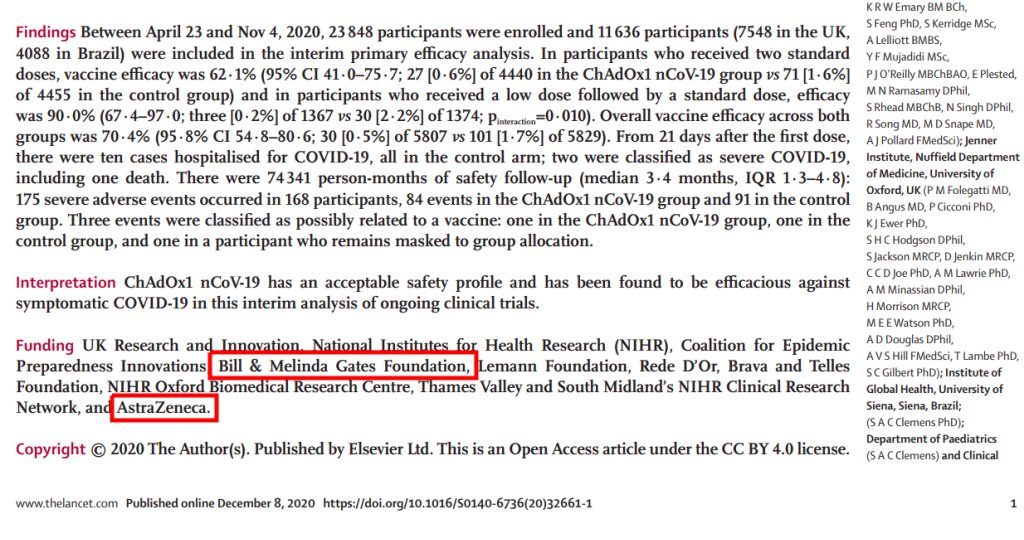
Randomised control trial study showing safety and efficacy of COVID-19 vaccine has clear conflicts of interest.
To guard against censorship, this is a mirror of the video posted by Leandra Ashton on 5 December.
New guidelines right? We can all see our loved ones if we have a negative test right?
On Dec 2nd my Mum asked for an in-person visit and was told ‘We have no tests’. Don’t worry, replied my Mum, I’ll get one done. The next day, having been tested she emailed a negative test result. This was met with another no: “We’re waiting for vaccinations before visiting can take place”.
The only option? Another inhumane window visit. Today, at the end of her 10 minute ‘visit’, kneeling on concrete by the window trying to connect with my Nan, my Mum raised concerns with the care assistant about how my Nan was looking. This is the response she was greeted with…
COVID-19 vaccines designed to elicit neutralising antibodies may sensitise vaccine recipients to more severe disease than if they were not vaccinated. Vaccines for SARS, MERS and RSV have never been approved, and the data generated in the development and testing of these vaccines suggest a serious mechanistic concern: that vaccines designed empirically using the traditional approach (consisting of the unmodified or minimally modified coronavirus viral spike to elicit neutralising antibodies), be they composed of protein, viral vector, DNA or RNA and irrespective of delivery method, may worsen COVID-19 disease via antibody-dependent enhancement (ADE). This risk is sufficiently obscured in clinical trial protocols and consent forms for ongoing COVID-19 vaccine trials that adequate patient comprehension of this risk is unlikely to occur, obviating truly informed consent by subjects in these trials.
The UK government has granted pharmaceutical giant Pfizer a legal indemnity protecting it from being sued, enabling its coronavirus vaccine to be rolled out across the country as early as next week.
The Department of Health and Social Care has confirmed the company has been given an indemnity protecting it from legal action as a result of any problems with the vaccine.
Ministers have also changed the law in recent weeks to give new protections to companies such as Pfizer, giving them immunity from being sued by patients in the event of any complications.
NHS staff providing the vaccine, as well as manufacturers of the drug, are also protected.
The army has mobilised an elite “information warfare” unit renowned for assisting operations against al-Qaeda and the Taliban to counter online propaganda against vaccines, as Britain prepares to deliver its first injections within days.
The defence cultural specialist unit was launched in Afghanistan in 2010 and belongs to the army’s 77th Brigade. The secretive unit has often worked side-by-side with psychological operations teams.
Leaked documents reveal that its soldiers are already monitoring cyberspace for Covid-19 content and analysing how British citizens are being targeted online.
https://www.thetimes.co.uk/edition/news/army-spies-to-take-on-antivax-militants-mfzsj66w2
Most people will escape “severe” side effects, defined as those that prevent daily activity. Fewer than 2% of recipients of the Pfizer and Moderna vaccines developed severe fevers of 39°C to 40°C. But if the companies win regulatory approvals, they’re aiming to supply vaccine to 35 million people worldwide by the end of December. If 2% experienced severe fever, that would be 700,000 people.
Other transient side effects would likely affect even more people. The independent board that conducted the interim analysis of Moderna’s huge trial found that severe side effects included fatigue in 9.7% of participants, muscle pain in 8.9%, joint pain in 5.2%, and headache in 4.5%. In the Pfizer/BioNTech vaccine trial, the numbers were lower: Severe side effects included fatigue (3.8%) and headache (2%).
But that’s a higher rate of severe reactions than people may be accustomed to. “This is higher reactogenicity than is ordinarily seen with most flu vaccines, even the high-dose ones,” says Arnold Monto, an epidemiologist at the University of Michigan School of Public Health.
https://web.archive.org/web/20201126203444/https://science.sciencemag.org/content/370/6520/1022
- Vaccine produced by a partnership between a University of Oxford research institute, Vaccitech, and AstraZeneca, does not need to be stored at freezing temperatures.
- Cheaper and easier to produce than the high-efficacy vaccines produced by BioNTech-Pfizer and Moderna.
- The price of AstraZeneca’s shares dropped on the news, and an analysis from an investment bank concluded, “We believe that this product will never be licensed in the US.”
- A closer look at the the Oxford-AstraZeneca trials reveals some very shaky science.
- Cherry-picked the data
- Dosing issues
- Opaque planning and data analysis procedures
- Age group selection
https://www.wired.com/story/the-astrazeneca-covid-vaccine-data-isnt-up-to-snuff/
Moderna Chief Medical Officer Tal Zaks warns on #AxiosOnHBO to not “over-interpret” vaccine results: “They do not show that they prevent you from potentially carrying this virus…and infecting others.” Adding, we shouldn’t “change behaviors solely on the basis of vaccination.”
Mirrors:
Two major U.S. pharmaceutical companies racing to develop novel coronavirus vaccines have announced that their vaccines have been confirmed to be over 90% effective. But Masayuki Miyasaka, a leading immunologist at Osaka University, told the Mainichi Shimbun in a recent interview that even after these vaccines become available, he does not plan to receive them for the time being.
At a meeting of the Committee on Health, Labor and Welfare of Japan’s House of Representatives on Nov. 17, Miyasaka stated, “There’s no doubt that their effectiveness is quite high, but their safety is not guaranteed at all,” sounding a word of caution about expectations for the vaccines.
https://mainichi.jp/english/articles/20201120/p2a/00m/0na/008000c
- The vaccine reduces symptoms; may prevent infection but this has not been proven.
- Mass testing is not the way out and could be very problematic.
- Around 1% of the population are infected and probably have no symptoms.
- If you are under 65, there is less risk than the regular flu.
- The number of people dying is the same as any other year.
- People of dying of respiratory diseases is about the same.
- Covid deaths will continue to go up.
- Hospitals are less full because they’ve increased their capacity; they’re not struggling to cope.
- Prevalence for the virus has plateaued.
- We should continue to be careful but COVID-19 is ‘not a major player’