Update 05 May 2020: Original video was removed from YouTube. Below is the mirror on Bitchute.
Lockdown
Browse the articles related to this topic below.
Join our community on Guilded.
Tony Heller compares COVID-19 with other pandemics and explains why the lockdown may create an even more devastating second wave.
Medical professionals say there never was a surge, hospital activity is at a low and we’re in danger of losing our capacity to deal with the second wave because we panicked.
When our American cousins cry “Live Free or Die” and take to the streets to protest overweening state authority during lockdown, whether they know it or not, they are honouring the tradition of English liberty.
But as I have said repeatedly, I see no evidence for the necessity of lockdown, for two reasons. Firstly because the case fatality rate of Covid-19 does not warrant it (the evidence points to between 0.1%-0.5%, and a recent study from Stanford University suggests it may be between 0.12% and 0.2%). And secondly, because I have seen no evidence to suggest that a lockdown strategy makes any real difference in reducing cases and deaths.
The eurozone economy suffered the steepest falls in business activity and employment ever recorded during April as a result of measures taken to contain the COVID-19 outbreak, according to provisional PMI® survey data. The month as saw unprecedented damage to the eurozone economy from lockdown measures coupled with slumping global demand and shortages of both staff and inputs.
BBC: Coronavirus: Deaths at 20-year high but peak may be over
Summary:
- “A third [of deaths in the week up to 10 April] were linked to coronavirus, but deaths from other causes also increased, suggesting the lockdown may be having an indirect impact on health.”
- “On Tuesday [21 April] 823 new deaths were announced, but most of these happened in the previous days and weeks. Some even date back to March.”
- “But the ONS also said deaths from other causes rose too.”
- “The number of deaths from flu and pneumonia…is three times higher than the total number of coronavirus deaths this year.”
Carl Heneghan, director of the centre for evidence-based medicine at Oxford University, said that the impact of the lockdown was “going to outweigh the damaging effect of coronavirus”.
Overall, however, the fact that good-sized regions from Utah to Sweden to much of East Asia have avoided harsh lockdowns without being overrun by Covid-19 is notable….And empirical analyses of national and regional response strategies…do not necessarily find that costly lockdowns work better against the virus than social distancing.
https://www.spiked-online.com/2020/04/22/there-is-no-empirical-evidence-for-these-lockdowns/
Many policies provide public-health benefits in pandemics, such as making facemasks mandatory, cancelling school, and banning large assemblies and long-distance travel. But ordering people to cower in their homes, harassing people for having playdates in the park, and ordering small businesses to close regardless of their hygienic procedures has no demonstrated effectiveness.
As the world went into lockdown, Sweden opted for a different approach to tackling coronavirus: cities, schools and restaurants have remained open. This was judged by critics to be utterly foolish: it would allow the virus to spread much faster than elsewhere, we were told, leading to tens of thousands of deaths.
I’m happy to say that those fears haven’t materialised.
https://www.spectator.co.uk/article/the-swedish-experiment-looks-like-it-s-paying-off
Currently, an estimated 2.6 billion people – one-third of the world’s population – is living under some kind of lockdown or quarantine. This is arguably the largest psychological experiment ever conducted.
Unfortunately, we already have a good idea of its results
In short, and perhaps unsurprisingly, people who are quarantined are very likely to develop a wide range of symptoms of psychological stress and disorder, including low mood, insomnia, stress, anxiety, anger, irritability, emotional exhaustion, depression and post-traumatic stress symptoms. Low mood and irritability specifically stand out as being very common, the study notes.
Oxford University Professor Carl Heneghan: UK’s outbreak peaked in March before lockdown but ministers had ‘lost sight’ of the scientific evidence and panicked.
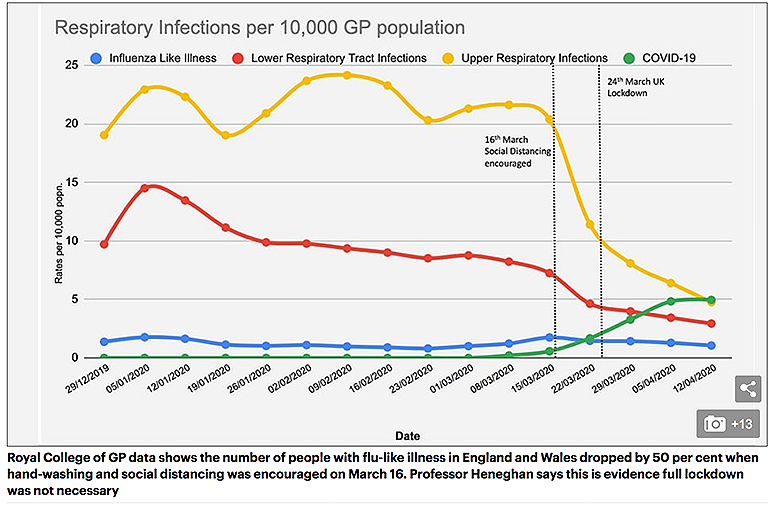
See coverage from 21st Century Wire: REVEALED: UK Ministers Knew Crisis Had Peaked Before Lockdown, But Panicked Anyway
See videos from Andrew Mather of who has been showing this by analysing WHO reports.
There needs to be a more effective and sustainable strategy to manage Covid-19 than the current economically ruinous policy, argue vets Dick Sibley and Joe Brownlie.
- UK policy on lockdown and other European countries are not evidence-based
- The correct policy is to protect the old and the frail only
- This will eventually lead to herd immunity as a “by-product”
- The initial UK response, before the “180 degree U-turn”, was better
- The Imperial College paper was “not very good” and he has never seen an unpublished paper have so much policy impact
- The paper was very much too pessimistic
- Any such models are a dubious basis for public policy anyway
- The flattening of the curve is due to the most vulnerable dying first as much as the lockdown
- The results will eventually be similar for all countries
- Covid-19 is a “mild disease” and similar to the flu, and it was the novelty of the disease that scared people.
- The actual fatality rate of Covid-19 is the region of 0.1%
- At least 50% of the population of both the UK and Sweden will be shown to have already had the disease when mass antibody testing becomes available
Summary from 21st Century Wire.