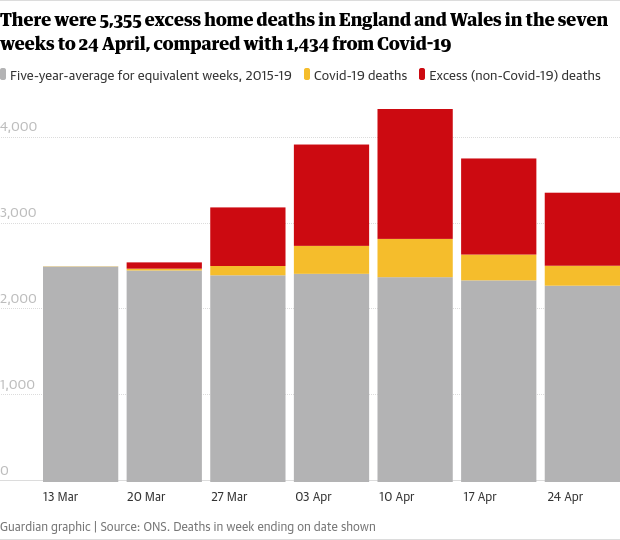
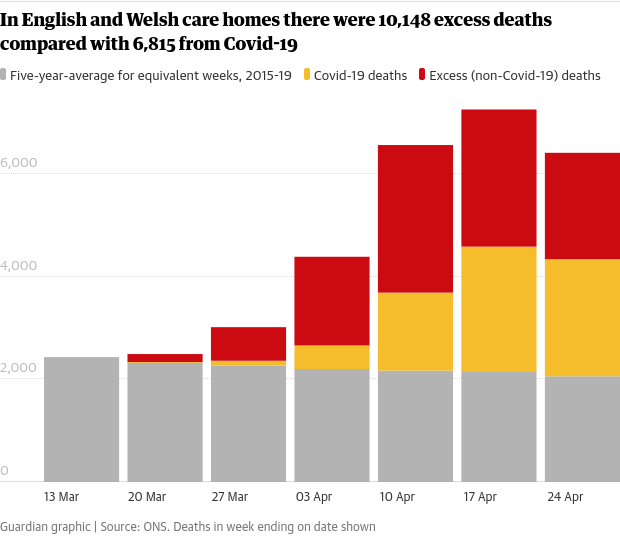
About 8,000 more people have died in their own homes since the start of the coronavirus pandemic than in normal times, a Guardian analysis has found, as concerns grow over the number avoiding going to hospital.
Of that total, 80% died of conditions unrelated to Covid-19, according to their death certificates. Doctors’ leaders have warned that fears and deprioritisation of non-coronavirus patients are taking a deadly toll.
“The two Chinese companies were offering a risky proposition: two million home test kits said to detect antibodies for the coronavirus for at least $20 million, take it or leave it.
The asking price was high, the technology was unproven and the money had to be paid upfront. And the buyer would be required to pick up the crate loads of test kits from a facility in China.
Yet British officials took the deal, according to a senior civil servant involved, then confidently promised tests would be available at pharmacies in as little as two weeks.”
Rapid antibody tests “have limited utility” for patients, the World Health Organization warned in an April 8 statement, telling doctors that such tests remained unfit for clinical purposes until they were proved to be accurate and effective.
…for thirteen years, taxpayer funding from the MRC went to Ferguson and his team, and all it produced was code that violated one of the most fundamental precepts of good software development – intelligibility.
University of College London scientists sampled and sequenced the genomes of virus samples from more than 7,500 people who caught COVID-19
Their findings suggest the pandemic began sometime between October 6 and December 11, 2019
The virus appears to be mutating about as frequently as expected
A March study suggested that two separate strains of coronavirus spread from China, with the more aggressive one becoming dominant in Europe and the US
Now, the University of College London researchers say that their study suggests just a single strain swiftly spread around the globe
It has mutated, but it’s unclear if those changes have made it more or less deadly
“There are really only two particularly unusual things about the Covid-19 epidemic: the timing of its arrival and the lockdown some countries declared.”
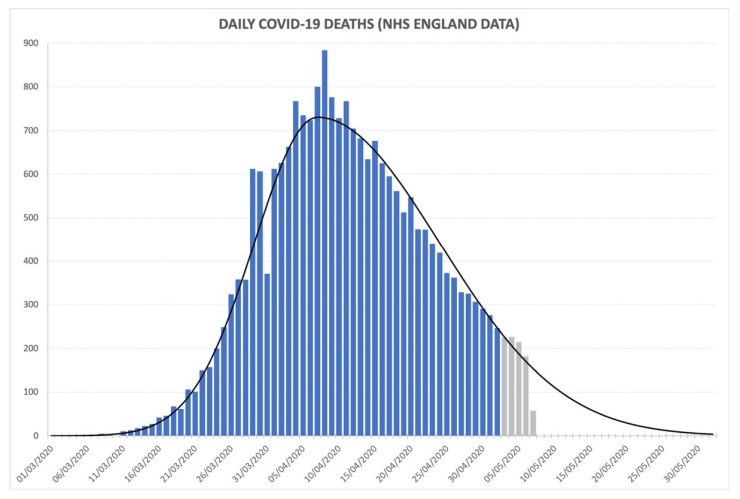
Deaths per day, as is well-reported, peaked around Easter; and because deaths lag infections by something around three weeks, this implies that infections peaked sometime in mid-March. If you add up all the bars in the chart and fill in the blank area of deaths still to come, we are looking at a killer that, in scale, is bad-but-nothing-special compared to killers of previous years. Panning out: as a killer worldwide, it looks as though Covid is going to take a toll perhaps 1% of 1918’s Spanish Flu.
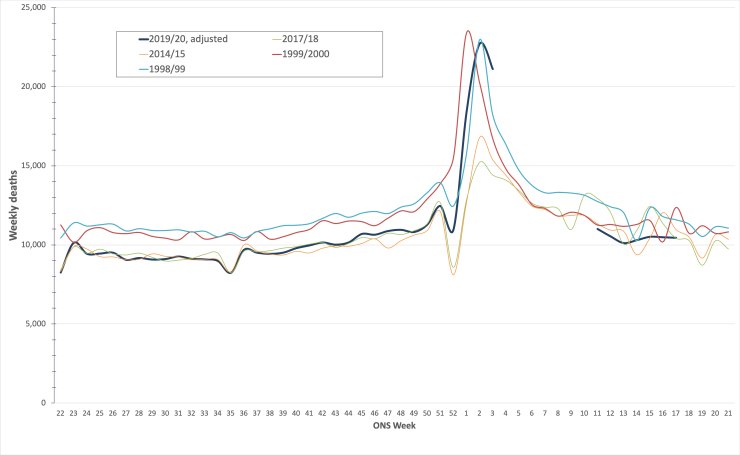
…the dark blue line is 2019-20, with Covid-19; the turquoise and red lines are the bad flu years of 1998-99 and 1999-2000.
…Covid-19 is narrowly in third place as a killer to remember, behind the 1998-99 and 1999-2000 influenzas (2017-18’s ‘Beast from the East’, the green line, doesn’t place), a point also made by American statistician William Briggs.
They stopped trying to provide profound and challenging explanations, according to their different points of view, of events or trends. They were too worried that such an approach might estrange readers. Likewise, articles and news items became shorter and shallower, because they were worried about the attention span of consumers, who were deemed all too ready to read the competition just a click away.
Something else shifted, too. Modern journalism ceased to try to report the facts, and then allow the reader to make up his or her own mind. Instead it started to act almost as a teacher, standing by the reader’s side, and guiding him or her towards the ‘right’ viewpoint.
Johan Giesecke, a state epidemiologist who advises the World Health Organisation, said the UK’s death toll suggested instating harsh social restrictions was not the best method of tackling the pandemic.
The risk of coronavirus for the young is “staggeringly low”, the UK’s top statistician has said – as he condemned the government’s “embarrassing” handling of Covid-19.
He made withering criticisms of the Government’s handling of the crisis, saying its treatment of statistics was “not trustworthy” and amounted to “number theatre” rather than an attempt to properly inform the public.
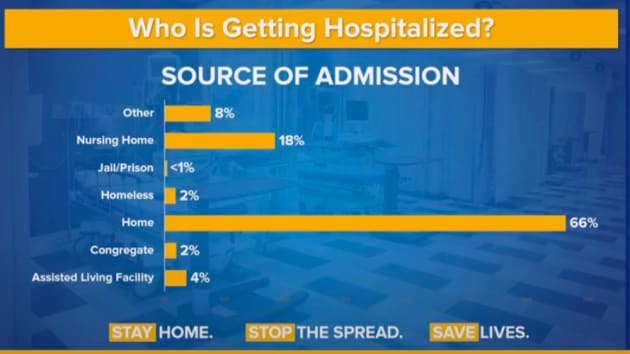
The vast majority of New Yorkers still walking into hospitals with COVID-19 have been sheltering at home and avoiding mass transit. Very few were even traveling on foot or in their own cars on a daily basis, according to a survey of new patients from over 100 hospitals across the state over a three-day span. Of those surveyed, 66% were at home before entering the hospital.
Two in three people coming into hospitals with the virus were simply at home, Cuomo said.
This Ferguson Model is such a joke it is either an outright fraud, or it is the most inept piece of programming I may have ever seen in my life. There is no valid test to warrant any funding of Imperial College for providing ANY forecast based upon this model. This is the most UNPROFESSIONAL operation perhaps in computer science. The entire team should be disbanded and an independent team put in place to review the world of Neil Ferguson and he should NOT be allowed to oversee any review of this model.
Normal life will be virtually impossible. Previously simple actions will be endlessly complicated and expensive. And while this farce continues, businesses will continue to close and jobs continue to vanish, visiting misery and sickness on millions.
I have seen this before in the old Communist world, a mad, fixed idea pursued by dense men relentlessly and without opposition or thought, until the whole thing collapses or explodes. Now I see it here.
The grim threshold was supposedly crossed when the UK’s mortality rate reached 29,427 deaths, seemingly surpassing Italy’s figure of 29,029. But those bald figures are like any other statistic, utterly devoid of meaning when stripped of context.
The government’s daily briefings on #Covid_19 are “not trustworthy communication of statistics” says Professor Sir David Spiegelhalter from the University of Cambridge
Professor Neil Ferguson of Imperial College “stepped back” from the Sage group advising ministers when his lockdown-busting romantic trysts were exposed. Perhaps he should have been dropped for a more consequential misstep. Details of the model his team built to predict the epidemic are emerging and they are not pretty. In the respective words of four experienced modellers, the code is “deeply riddled” with bugs, “a fairly arbitrary Heath Robinson machine”, has “huge blocks of code – bad practice” and is “quite possibly the worst production code I have ever seen”.
I have not seen the police like this before. Sure, I’ve seen police heavy-handedness; I’ve actually encountered it, on demonstrations many years ago. I’ve seen police harassing homeless people for no good reason. I’ve seen the over-policing of certain streets and certain communities and seen how dispiriting people find it. But this arrogant, sneering barking of orders at sunbathers and mums and homeless people resting under trees on a warm day is completely new. It is lockdown fanaticism in action. This rude and heartless officiousness is the logical conclusion of the culture of hysteria our political and media elites have whipped up over Covid-19.
Covid-19 test kits in Tanzania have raised suspicion after samples taken from a goat and a pawpaw fruit came back with positive results, as the president said there were “technical errors”.
Relaxing stay-at-home orders and allowing some types of non-essential businesses such as shops to reopen are the lowest risk measures to get the UK and other European countries out of lockdown – according to research from the University of East Anglia.
Stay-home policies were not associated with a decline in incidence, and actually showed a positive association with cases. As the number of lock-down days increased, so did the number of cases.
Face coverings may even be associated with increased risk, but the data quality for this is very uncertain.
Traffic log cookies are used to measure site traffic. We'll assume you're ok with this, but you can opt-out if you wish. Cookie settingsACCEPT
Privacy & Cookies Policy
Privacy Overview
This website uses cookies to improve your experience while you navigate through the website. Out of these cookies, the cookies that are categorized as necessary are stored on your browser as they are essential for the working of basic functionalities of the website. We also use third-party cookies that help us analyze and understand how you use this website. These cookies will be stored in your browser only with your consent. You also have the option to opt-out of these cookies. But opting out of some of these cookies may have an effect on your browsing experience.
Necessary cookies are absolutely essential for the website to function properly. This category only includes cookies that ensures basic functionalities and security features of the website. These cookies do not store any personal information.
Any cookies that may not be particularly necessary for the website to function and is used specifically to collect user personal data via analytics, ads, other embedded contents are termed as non-necessary cookies. It is mandatory to procure user consent prior to running these cookies on your website.