Doctors have told The BMJ they are deeply concerned at the number of patients becoming infected with covid-19 in NHS hospitals in England and have called for more stringent infection control measures to combat its spread.
Transmission
Browse the articles related to this topic below.
Join our community on Guilded.
The key findings are that <50% of participants were adherent with mask use and that the intention-to-treat analysis showed no difference between arms. Although our study suggests that community use of face masks is unlikely to be an effective control policy for seasonal respiratory diseases, adherent mask users had a significant reduction in the risk for clinical infection. Another recent study that examined the use of surgical masks and handwashing for the prevention of influenza transmission also found no significant difference between the intervention arms.
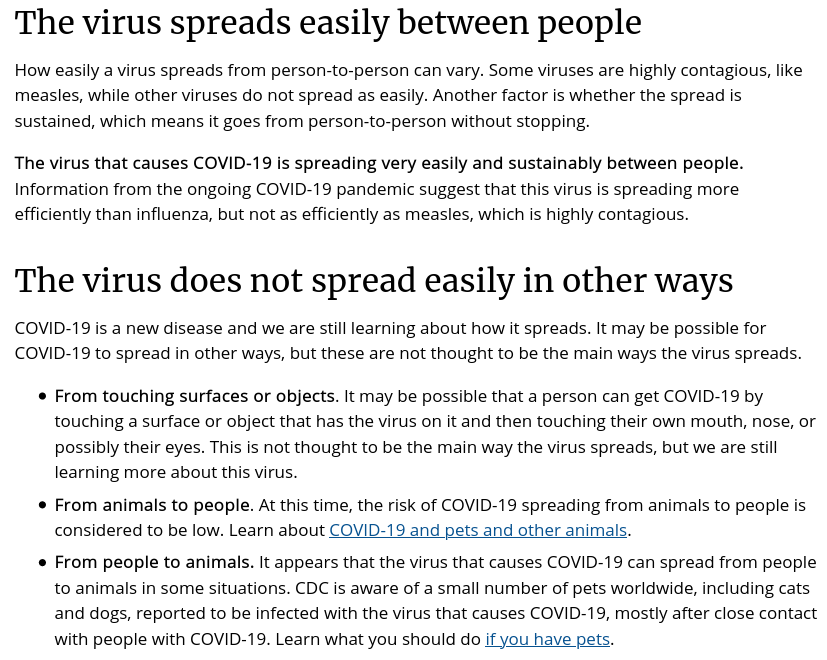
This is a screenshot and excerpt from the CDC page updated 13 April 2020.
https://www.cdc.gov/coronavirus/2019-ncov/prevent-getting-sick/how-covid-spreads.html
Person-to-person spread
The virus is thought to spread mainly from person-to-person.
- Between people who are in close contact with one another (within about 6 feet).
- Through respiratory droplets produced when an infected person coughs, sneezes, or talks.
- These droplets can land in the mouths or noses of people who are nearby or possibly be inhaled into the lungs.
- COVID-19 may be spread by people who are not showing symptoms.
The virus spreads easily between people
How easily a virus spreads from person-to-person can vary. Some viruses are highly contagious, like measles, while other viruses do not spread as easily. Another factor is whether the spread is sustained, which means it goes from person-to-person without stopping.
The virus that causes COVID-19 is spreading very easily and sustainably between people. Information from the ongoing COVID-19 pandemic suggest that this virus is spreading more efficiently than influenza, but not as efficiently as measles, which is highly contagious.
The virus does not spread easily in other ways
COVID-19 is a new disease and we are still learning about how it spreads. It may be possible for COVID-19 to spread in other ways, but these are not thought to be the main ways the virus spreads.
- From touching surfaces or objects. It may be possible that a person can get COVID-19 by touching a surface or object that has the virus on it and then touching their own mouth, nose, or possibly their eyes. This is not thought to be the main way the virus spreads, but we are still learning more about this virus.
- From animals to people. At this time, the risk of COVID-19 spreading from animals to people is considered to be low. Learn about COVID-19 and pets and other animals.
- From people to animals. It appears that the virus that causes COVID-19 can spread from people to animals in some situations. CDC is aware of a small number of pets worldwide, including cats and dogs, reported to be infected with the virus that causes COVID-19, mostly after close contact with people with COVID-19. Learn what you should do if you have pets.
NHS England figures reveal some infections were passed on by hospital staff unaware they had virus.
Up to a fifth of patients with Covid-19 in several hospitals contracted the disease over the course of the pandemic while already being treated there for another illness, NHS bosses have told senior doctors and nurses.
https://www.theguardian.com/world/2020/may/17/hospital-patients-england-coronavirus-covid-19
“It is so transmissible, it’s so successful, we’re so susceptible, that actually it’s a little bit of a red herring to worry about it getting worse, because it couldn’t be much worse at the moment in terms of the numbers of cases,” he told the House of Lords Science and Technology committee on Tuesday.
“If you contrast with Ebola, which has very high virulence, kills many, many people, it makes it very controllable and you can very readily identify the infected people.
- Professor Karol Sikora says that COVID-19 behaves like pandemics in the past.
- Society is scarred all over the world.
- The virus will go but the fear will do the damage.
Note: YouTube has taken down the video. Please go directly to UnHerd’s site:
https://unherd.com/thepost/professor-karol-sikora-fear-is-more-dangerous-than-the-virus/
Professor Karol Sikora has become something of a celebrity in the UK over the past months for his expert commentary on the pandemic, and his unusual tendency for optimism rather than pessimism.
Virus ‘getting tired’
– In the past two weeks, the virus is showing signs of petering out
– It’s as though the virus is ‘getting tired’, almost ‘getting bored’
– It’s happening across the world at the same time
Existing herd immunity
– The serology results around the world (and forthcoming in Britain) don’t necessarily reveal the percentage of people who have had the disease
– He estimates 25-30% of the UK population has had Covid-19, and higher in the group that is most susceptible
– Pockets of herd immunity help *already* explain the downturn
– Sweden’s end result will not be different to ours – lockdown versus no lockdown
Fear more deadly than the virus
– When the history books are written, the fear will have killed many more people than the virus, including large numbers of cancer and cardiological patients not being treated
– We should have got the machinery of the NHS for non-corona patients back open earlier
Masks and schools
– Evidence on masks is just not there either way so it should be an ‘individual decision’
– We should move to 1m social distancing which means restaurants and bars could reopen
– More schools should reopen in June as ‘children are not the transmitters of this virus’
– We should be getting back to the ‘old normal’ not a ‘new normal’
Don’t Forget The Bubbles — a blog for medical professionals specializing in pediatrics — partnered with the UK Royal College of Pediatrics and Child Health to track and review studies on COVID-19 in children, according to its website. Using research from 78 of those studies, it released a 45-page report on April 22 that extracts early findings on the epidemiology, transmission and symptoms of the coronavirus in children.
Conclusion:
The role of children in transmission is unclear, but it seems likely they do not play a significant role.
https://dontforgetthebubbles.com/wp-content/uploads/2020/04/COVID-data-top-10.pdf
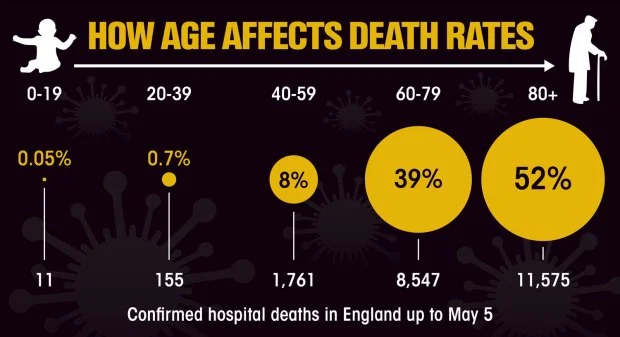
FEWER than one per cent of Covid-19 deaths in England’s hospitals has been among people under the age of 40, NHS data reveals.
Just 11 people below the age of 20 have been killed by the bug out of 22,049 confirmed fatalities. And there have been only 155 deaths in the 20 to 39 age bracket — with many of those tragedies coming among people with underlying health conditions.
That equates to just 0.75 per cent of hospital fatalities within the under-40s. Conversely, 52 per cent of those whose deaths are tied to coronavirus have been in the over-80s.
https://www.thesun.co.uk/news/11566129/under-40s-less-1-percent-coonavir
University of College London scientists sampled and sequenced the genomes of virus samples from more than 7,500 people who caught COVID-19
Their findings suggest the pandemic began sometime between October 6 and December 11, 2019
The virus appears to be mutating about as frequently as expected
A March study suggested that two separate strains of coronavirus spread from China, with the more aggressive one becoming dominant in Europe and the US
Now, the University of College London researchers say that their study suggests just a single strain swiftly spread around the globe
It has mutated, but it’s unclear if those changes have made it more or less deadly
New study analysing dozens of actual Covid-19 clusters from around the world shows enclosed spaces are hotbeds of the virus
- The overall infection rate was six per cent, but it was much higher among friends (22 per cent) and family members (18 per cent).
- In terms of location, the main risk factors were homes (13 per cent) transport (12 per cent) and dinner and entertainment (seven per cent).
- Risk of infection is much higher within households or other enclosed environments in which contact is close and sustained.
- In the outdoors, it falls to something in the 0-5 per cent range.
- Children, it seems, are not only better able to resist the infection within the home but also less likely to bring it back with them.
- Close and prolonged contact is required for transmission of the virus.
- Risk is highest in enclosed environments such as houses, care facilities, public transport, bars and other indoor spaces where people congregate.
- Casual, short interactions are not the main driver of the epidemic.
- Susceptibility to infection increases with age.
- Just 11 people under the age of 20 have succumbed to Covid-19.
- Professor Neil Ferguson of Imperial College has a dismal record as a forecaster.
- There’s the possibility that the lockdown has actually made the virus more deadly.
- Bank of England warned that if the lockdown is extended until June the economy could shrink by 14 per cent this year.
- More than one-in-five adults now furloughed on 80per cent of their wages.
- A fifth of the working-age population could be jobless and the quality of people’s mental and physical health would plummet.
- Every day, about 1,700 people die in Britain. Only five years ago, in the winter of 2014/15, more than 28,000 people died from seasonal flu, not far off the current coronavirus death toll of just over 30,000.
- Direct evidence to support the two-metre rule is weak, and based almost entirely on modelling rather than real life.
The Covid threat is not the apocalypse we were warned about. Its death rate is low. Its impact on younger people is negligent. Just 0.75 per cent of deaths in the UK have been among under-40s, and the majority of those were people with underlying health conditions. And yet most under-40s – fit, healthy workers – remain locked at home, denied the right to work and play and keep society going.
The horror stories that were spread about Covid-19 by government officials and media fearmongers have been exposed as inaccurate, and in some cases hysterical. As the government adviser Professor Robert Dingwall says, the government has ‘effectively terrorised’ us into ‘believing that this is a disease that is going to kill you’. When in the vast majority of cases that simply isn’t true. As Professor Dingwall points out, 80 per cent of people who get the virus never have to go to a hospital, and of those who do, ‘most of them will come out alive – even those who go into intensive care’.
https://www.spiked-online.com/2020/05/08/lockdown-fanatics-scare-me-far-more-than-covid-19/
The horrible truth is that it now looks like in many of the early cases, the disease was probably caught in hospitals and doctors’ surgeries. That is where the virus kept returning, in the lungs of sick people, and that is where the next person often caught it, including plenty of healthcare workers. Many of these may not have realised they had it, or thought they had a mild cold. They then gave it to yet more elderly patients who were in hospital for other reasons, some of whom were sent back to care homes when the National Health Service made space on the wards for the expected wave of coronavirus patients.
Once the epidemic is under control in hospitals and care homes, the disease might die out anyway, even without lockdown. In sharp contrast to the pattern among the elderly, children do not transmit the virus much if at all. A recent review by paediatricians could not find a single case of a child passing the disease on and said the evidence ‘consistently demonstrates reduced infection and infectivity of children in the transmission chain’. One boy who caught it while skiing failed to give it to 170 contacts, but he also had both flu and a cold, which he donated to two siblings. Children appear to have ACE2 receptors, the cellular lock that the coronavirus picks, in their noses but not their lungs.
https://www.spectator.co.uk/article/we-know-everything-and-nothing-about-covid
At the current time, children do not appear to be super spreaders. Sero-surveillance data will not be available to confirm or refute these findings prior to the urgent policy decisions that need to be taken in the next few weeks such as how and when to re-open schools. Policies for non-pharmacological interventions involving children are going to have to be made on a risk–benefit basis with current evidence available.
https://adc.bmj.com/content/early/2020/05/05/archdischild-2020-319474
Perspectives on the Pandemic – Episode 6: When Dr. Dan Erickson and Dr. Antin Massihi held a press conference on April 22nd about the results of testing they conducted at their urgent care facilities around Bakersfield, California, the video, uploaded by a local ABC news affiliate, went viral. After reaching five million views, YouTube took it down on the grounds that it “violated community standards.” We followed up with the doctors to determine what was so dangerous about their message. What we discovered were reasonable and well-meaning professionals whose voices should be heard.
This video has been removed by YouTube so a Bitchute mirror is provided below. Please wait after pressing the play button. It may take longer than usual to load the video.

- Professor Neil Ferguson was not doing science.
- Lockdowns are worse than useless.
- It was known to everyone that the lockdown would cause a catastrophe.
- Isolating nursing homes would have prevented the load of hospitals.
- The lockdown approach taken by most governments was a human catastrophe that should never have happened.
- All we have done is slowed the spread of herd immunity and increased the risk to the elderly.
- We have wasted a lot of time, money and lives.
- The spread of respiratory diseases are predictable and relatively short.
- Bill Gate’s comments about the need to lockdown until a vaccine is ready is absurd and has nothing to do with reality.
- We don’t need a vaccine for COVID-19.
- “I don’t know where the government finds these so-called experts who very obviously don’t understand the very basics of epidemiology.”
- Tragic stories from some doctors are not representative of the general experience. We don’t stop living our lives because something goes wrong in a particular place.
- The Swedish approach shows that the draconian measures taken in other countries were unnecessary.
- We may see a ‘Second Wave’ rebound but it may be low.
- There is no reason to believe that COVID-19 will be fundamentally different from other coronaviruses.
- Having a novel virus is not novel.
- We have no science about the effect of social distancing.
- The COVID-19 disaster is a failure of the people to take control of the government.
- There is no reason to wait before opening up schools and businesses.
The COVID-19 epidemic curves are consistent and follow the Gompertz curve. Similar distributions have been reported for Influenza, such as the 1918/19 epidemic in Prussia.

https://tbiomed.biomedcentral.com/articles/10.1186/1742-4682-4-20