One in five people in England may have had coronavirus, new modelling suggests, equivalent to 12.4 million people, rising to almost one in two in some areas.
It means that across the country as a whole the true number of people infected to date may be five times higher than the total number of known cases according to the government’s dashboard.
In some areas, however, the disparity may be even greater. Parts of London and the south are estimated to have had up to eight times as many cases as have been detected to date.
The analysis, by Edge Health, reveals that the true number of coronavirus infections in England could be as high as 12.4 million, equivalent to 22% of the population, as of 3 January.
EvidenceNotFear
Browse the articles related to this topic below.
Join our community on Guilded.
Trademark symptoms of seasonal flu could be mistaken for symptoms of Covid-19, it is claimed
People with common colds who are testing positive for Covid-19 may simply be asymptomatic cases, experts have said.
Trademark symptoms of seasonal flu could be mistaken for symptoms of Covid-19 if the individual tests positive for the virus, it is claimed.
More than eight in ten people who test positive for coronavirus show none of the main symptoms at the time they are tested, a major study by UCL previously revealed.
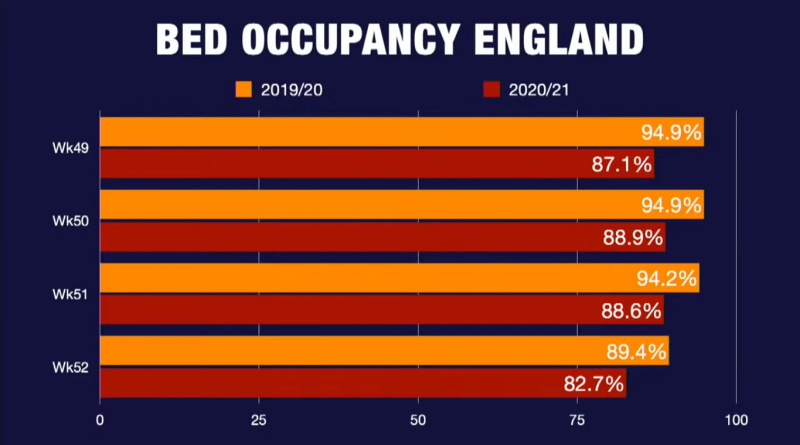
When announcing the national lockdown, Prime Minister Boris Johnson said the NHS risked being overwhelmed if the measures weren’t taken.
But statistics suggest that the proportion of beds currently occupied by patients is actually lower than usual.
So how can both things be true?
…To create that wiggle room, there has been a big decrease in patients coming in for non-urgent operations and outpatient appointments, to ensure that space is there and pressures are not increased.
Even in September 2020, when hospitals were beginning to increase the number of operations carried out, these were still 25% lower than in previous years.
This also helps explain why there are also fewer patients in hospitals this year, as well as fewer beds.
The impact of this is a large backlog and the potential for certain treatments – such as cancer care – being delayed.
https://web.archive.org/web/20210107152338/https://www.bbc.co.uk/news/55536762
Hypnotherapists have been noticing blatant hypnosis and Neuro-linguistic programming (NLP) techniques being used by the government and state-controlled media. NPL is a psychological approach that involves analyzing strategies used by successful individuals and applying them to reach a personal goal. It relates thoughts, language, and patterns of behavior learned through experience to specific outcomes.
Nursery schools present “very little risk” and are Covid-safe, vaccine minister Nadhim Zahawi has said, as he defended keeping them open.
Mr Zahawi’s wife, Lana Saib, has a controlling interest in Warren Medical Ltd, which was set up in June according to Companies House records.
https://www.mirror.co.uk/news/politics/vaccines-minister-defends-family-setting-23269433
Background and Aims
The most restrictive non‐pharmaceutical interventions (NPIs) for controlling the spread of COVID‐19 are mandatory stay‐at‐home and business closures. Given the consequences of these policies, it is important to assess their effects. We evaluate the effects on epidemic case growth of more restrictive NPIs (mrNPIs), above and beyond those of less restrictive NPIs (lrNPIs).
Methods
We first estimate COVID‐19 case growth in relation to any NPI implementation in subnational regions of 10 countries: England, France, Germany, Iran, Italy, Netherlands, Spain, South Korea, Sweden, and the US. Using first‐difference models with fixed effects, we isolate the effects of mrNPIs by subtracting the combined effects of lrNPIs and epidemic dynamics from all NPIs. We use case growth in Sweden and South Korea, two countries that did not implement mandatory stay‐at‐home and business closures, as comparison countries for the other 8 countries (16 total comparisons).
Results
Implementing any NPIs was associated with significant reductions in case growth in 9 out of 10 study countries, including South Korea and Sweden that implemented only lrNPIs (Spain had a non‐significant effect). After subtracting the epidemic and lrNPI effects, we find no clear, significant beneficial effect of mrNPIs on case growth in any country. In France, e.g., the effect of mrNPIs was +7% (95CI ‐5%‐19%) when compared with Sweden, and +13% (‐12%‐38%) when compared with South Korea (positive means pro‐contagion). The 95% confidence intervals excluded 30% declines in all 16 comparisons and 15% declines in 11/16 comparisons.
Conclusions
While small benefits cannot be excluded, we do not find significant benefits on case growth of more restrictive NPIs. Similar reductions in case growth may be achievable with less restrictive interventions.
- YouTube shut down TalkRadio’s channel ‘for violating community guidelines’
- TalkRadio is urgently seeking answers from Google about channel removal
- Station has aired criticism of government use of coronavirus lockdowns
Narratives about complaints in children and adolescents caused by wearing a mask are accumulating. There is, to date, no registry for side effects of masks.
By 26.10.2020 the registry had been used by 20,353 people. In this publication we report the results from the parents, who entered data on a total of 25,930 children. The average wearing time of the mask was 270 minutes per day. Impairments caused by wearing the mask were reported by 68% of the parents. These included irritability (60%), headache (53%), difficulty concentrating (50%), less happiness (49%), reluctance to go to school/kindergarten (44%), malaise (42%) impaired learning (38%) and drowsiness or fatigue (37%).
hat happened was fairly simple, I’ve come to believe. It was an accident. A virus spent some time in a laboratory, and eventually it got out. SARS-CoV-2, the virus that causes COVID-19, began its existence inside a bat, then it learned how to infect people in a claustrophobic mine shaft, and then it was made more infectious in one or more laboratories, perhaps as part of a scientist’s well-intentioned but risky effort to create a broad-spectrum vaccine. SARS-2 was not designed as a biological weapon. But it was, I think, designed. Many thoughtful people dismiss this notion, and they may be right. They sincerely believe that the coronavirus arose naturally, “zoonotically,” from animals, without having been previously studied, or hybridized, or sluiced through cell cultures, or otherwise worked on by trained professionals. They hold that a bat, carrying a coronavirus, infected some other creature, perhaps a pangolin, and that the pangolin may have already been sick with a different coronavirus disease, and out of the conjunction and commingling of those two diseases within the pangolin, a new disease, highly infectious to humans, evolved. Or they hypothesize that two coronaviruses recombined in a bat, and this new virus spread to other bats, and then the bats infected a person directly — in a rural setting, perhaps — and that this person caused a simmering undetected outbreak of respiratory disease, which over a period of months or years evolved to become virulent and highly transmissible but was not noticed until it appeared in Wuhan.
In the first half of 2020, responses to the COVID-19 pandemic led to steep declines in global petroleum demand and to volatile crude oil markets. The second half of the year was characterized by relatively stable prices as demand began to recover. As petroleum demand fell and U.S. crude oil inventories increased, West Texas Intermediate (WTI) crude oil traded at negative prices on April 20, the first time the price for the WTI futures contract fell to less than zero since trading began in 1983. The next day, Brent crude oil, another global crude oil price benchmark, fell to $9.12 per barrel (b), its lowest daily price in decades.


[W]e require the current economic shock, which is much larger than 2008, to result in much smaller life loss than was associated with 2008. Otherwise we will lose more life to the economic effects of Covid-19 suppression efforts than were ever likely to have been lost to Covid-19 itself. Of course the consequences of the 2008 crisis were amplified by the policies adopted thereafter, and perhaps those consequences could have been substantially alleviated by a more enlightened approach. But the historical record from the UK does not suggest a willingness to vote for such an approach, even if any sort of credible plan for avoiding the economic life loss were actually to be proposed. The 1945 election was perhaps the exception, but it’s unclear that several months stuck at home on your sofa really leads to the same sort of cathartic re-evaluation of life’s priorities as storming the beaches of Normandy.


https://web.archive.org/web/20201101062720/https://www.maths.ed.ac.uk/~swood34/
- The mortality rate is below 0.2%.
- For most people the risk of dying if you get infected is less than one in 500 (and less than one in 3,000 if you’re below 70 years of age).
- The disease preferentially strikes people who are anyway very close to the end of life/
- The amount of lifetime lost when someone dies of the disease is usually small.
- 2020 will likely turn out to have been a very average year in terms of overall mortality.
- 98% of people who get covid are fully recovered within three months.
- There is no good evidence that covid results in long term health consequences.
- Chinese realized early on that covid-19 wasn’t very serious, no worse than a bad flu.
- China is still reporting less than 20 cases per day.
- China is claiming that less than 5,000 people have so far died of covid in China. That’s less than Sweden, a country with less than 1% of China’s population.
HOSPITALS had almost fifteen percent fewer patients this December compared with 2019, despite the Covid crisis.
But they are being ovewhelmed by the surge in infections because of a lack of beds and staff, experts said.A freedom of information request to NHS England revealed that on December 22, three days after Boris Johnson introduced tier four for millions, more than 13,000 fewer beds were occupied than the same date in 2019.
The new data suggests a key reason hospitals are struggling is this lack of capacity.
Categories
The Cruise Ship Suicides – Bloomberg
Confined mostly to tiny cabins as the pandemic unfolded, crew members struggled to cope.
There are so many cases where – even if the COVID19 test was accurate – COVID19 would have had nothing whatsoever to do with the death. Another thing known, or at least we probably know, is that the vast majority of people who die had many other things wrong with them.
In the US, the Centre of Disease Control (CDC) found that ninety-four per cent of people who died of COVID19 ‘related deaths’ had other significant diseases (co-morbidities) 2. This ninety-four per-cent figures would only be the co-morbidities that were known about – who knows what lurked beneath? Especially as people stopped doing post-mortems (i.e., autopsies in the US).
So yes, they had COVID19 (or at least they had a positive test – which may not be the same thing), but they were often very old, and already severely ill. Using an extreme example, someone with terminal cancer who is a week from death, catches COVID19 in hospital, and dies. What killed them? The statistics say COVID19. I say, bollocks.
…If I were to recommend actions. I would recommend that we stop testing – unless someone is admitted to hospital and is seriously ill. Mass testing is simply causing mass panic and achieves absolutely nothing. At great cost. We should also just get on with our lives as before. We should just vaccinate those at greatest risk of dying, the elderly and vulnerable, and put this rather embarrassing episode of mad banner waving behind us.
https://drmalcolmkendrick.org/2020/12/30/what-is-left-to-say/
Almost three times as many under 60s died in road crashes last year as those without health conditions killed by coronavirus, NHS data shows.
Just 388 people under the age of 60 with no underlying health conditions have died of coronavirus in England, NHS data has revealed.
ONLY 388 people aged under 60 without underlying health conditions have died of coronavirus in hospitals across England, NHS data shows.
The figure is just 0.8 per cent of all Covid fatalities recorded in English hospitals between April 2 and December 23.

First COVID-19 outpatient study based on risk stratification and early antiviral treatment at the beginning of the disease.
Low-dose hydroxychloroquine combined with zinc and azithromycin was an effective therapeutic approach against COVID-19.
Significantly reduced hospitalisation rates in the treatment group.
Reduced mortality rates in the treatment group.